
Fleets, manufacturers, and test labs across the US rely on strain-gauge-based sensors for continuous load and weight monitoring. Yet many operators and engineers don't fully grasp how the bridge converts those tiny changes into usable voltage, which leads to confusion when choosing between quarter, half, and full bridge setups.
This guide breaks down how the circuit works, stage by stage, and where it shows up in real equipment.
Key Takeaways
- A Wheatstone bridge uses four resistors to turn tiny strain-gauge resistance changes into measurable voltage
- Balanced bridges output zero voltage; strain-induced imbalance creates a proportional signal
- Quarter, half, and full bridges use 1, 2, or 4 active gauges, trading sensitivity for temperature compensation
- The same circuit powers load cells, pressure transducers, and onboard vehicle scales in trucking and industrial weighing
- Choosing the right bridge type helps engineers and fleet operators match sensor accuracy and stability to their application
What Is a Wheatstone Bridge Strain Gauge Circuit?
A Wheatstone bridge is a four-arm resistor network. Samuel Hunter Christie developed the concept in 1833. Sir Charles Wheatstone popularized its practical uses about ten years later, according to Micro-Measurements' history of the circuit.
Here's why it exists: a strain gauge's resistance change from mechanical deformation is tiny, typically on the order of 10⁻⁴ to 10⁻² ohm/ohm. A basic ohmmeter or simple voltage divider can't reliably resolve a change that small. The bridge circuit can.
The Wheatstone bridge is not a strain gauge. It's the measurement circuit that one or more strain gauges are wired into so their resistance change can be detected as voltage.
Despite newer digital sensing approaches, the bridge remains the industry standard. Its sensitivity-to-cost ratio for resistive sensors is hard to beat.
There are three main configurations:
- Quarter bridge — one active gauge
- Half bridge — two active gauges
- Full bridge — four active gauges
Gauge placement and wiring differ significantly between these, which affects both sensitivity and how well the circuit compensates for temperature swings.
How Does a Wheatstone Bridge Strain Gauge Circuit Work?
The circuit runs through three stages — excitation, imbalance detection, and voltage output — that together turn mechanical strain into an electrical signal.
Initiation (Excitation)
The process starts with a stable DC or AC excitation voltage applied across two opposite corners of the four-resistor diamond network. Once the sensor is powered, excitation runs continuously with no manual trigger.
One common bottleneck: unstable or noisy excitation voltage introduces measurement error. Regulated power supplies keep that error in check.
Core Operation (Balance and Imbalance)
The bridge is "balanced" when resistance ratios in both halves are equal, producing zero output voltage. In NI's arm convention, balance occurs when R1/R2 = R4/R3 — any deviation from that ratio makes the output nonzero, according to NI's strain gauge measurement guide.
Apply strain, and the active gauge's resistance shifts by a small amount (ΔR). That unbalances the bridge and creates a voltage difference between the midpoints.
More active gauges mean more output voltage for the same strain:
| Configuration | Active Gauges | Relative Sensitivity | Temperature Compensation |
|---|---|---|---|
| Quarter bridge | 1 | Baseline | Requires added dummy gauge |
| Half bridge | 2 | ~2x quarter bridge | Built into two-gauge arrangement |
| Full bridge | 4 | Up to 4x quarter bridge | Best matching, best cancellation |
NI's benchmarks show half bridges roughly doubling quarter-bridge sensitivity, with full-bridge Type I configurations reaching about four times the quarter-bridge output.

Regulation / Control (Compensation)
Bridges maintain accuracy under changing conditions using temperature-compensating dummy gauges or matched gauge pairs. When two gauges experience the same temperature, their resistance ratio stays stable and cancels out unwanted thermal drift.
Other compensation techniques include:
- Shielding to block electrical noise pickup
- Guarding to isolate signal paths
- Lead-wire compensation for resistance errors on long cable runs
Uncompensated bridges drift with temperature or pick up electrical noise. That produces false readings outside a controlled lab, which is where fleet-mounted sensors operate.
Output / Result
The final output is a small, proportional voltage, often amplified, representing the applied force, pressure, or weight. That signal feeds downstream into digital displays, data loggers, or wireless transmitters for real-time monitoring.
Compensation quality drives output quality. A well-compensated full-bridge circuit yields more linear, stable readings—critical when the displayed weight decides whether a truck is legally loaded.

Where Is the Wheatstone Bridge Strain Gauge Circuit Used?
This circuit shows up anywhere small mechanical deformation needs precise detection:
- Structural testing — measuring stress in materials and components
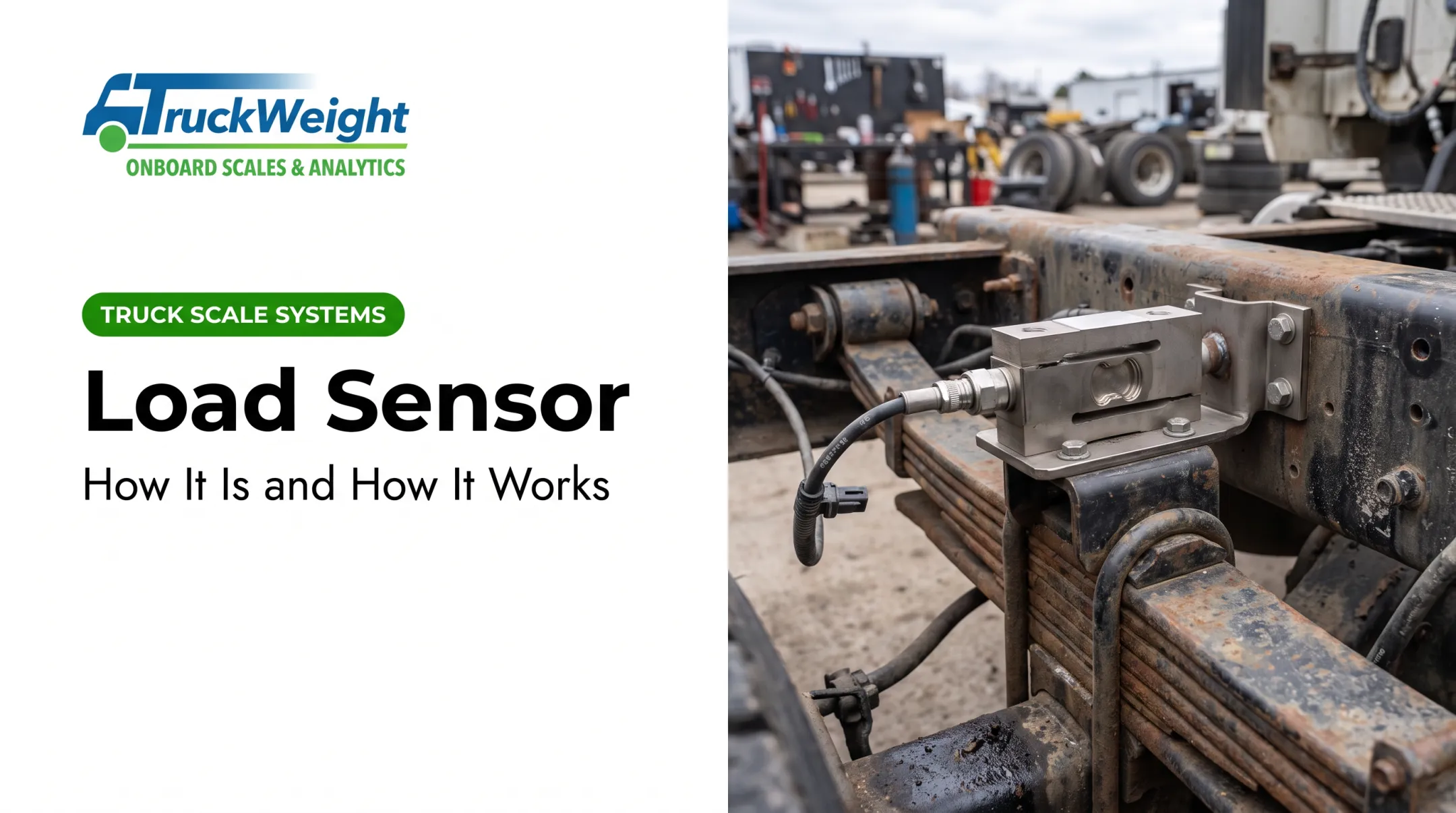
- Load cell manufacturing — the core sensing element in nearly every commercial load cell
- Pressure transducers — strain gauges on a measuring body, wired as a full bridge
- Onboard vehicle weighing systems — continuous axle and gross vehicle weight monitoring
It performs best in harsh, vibration-heavy, or outdoor environments where high-precision detection still needs to hold up under stress.
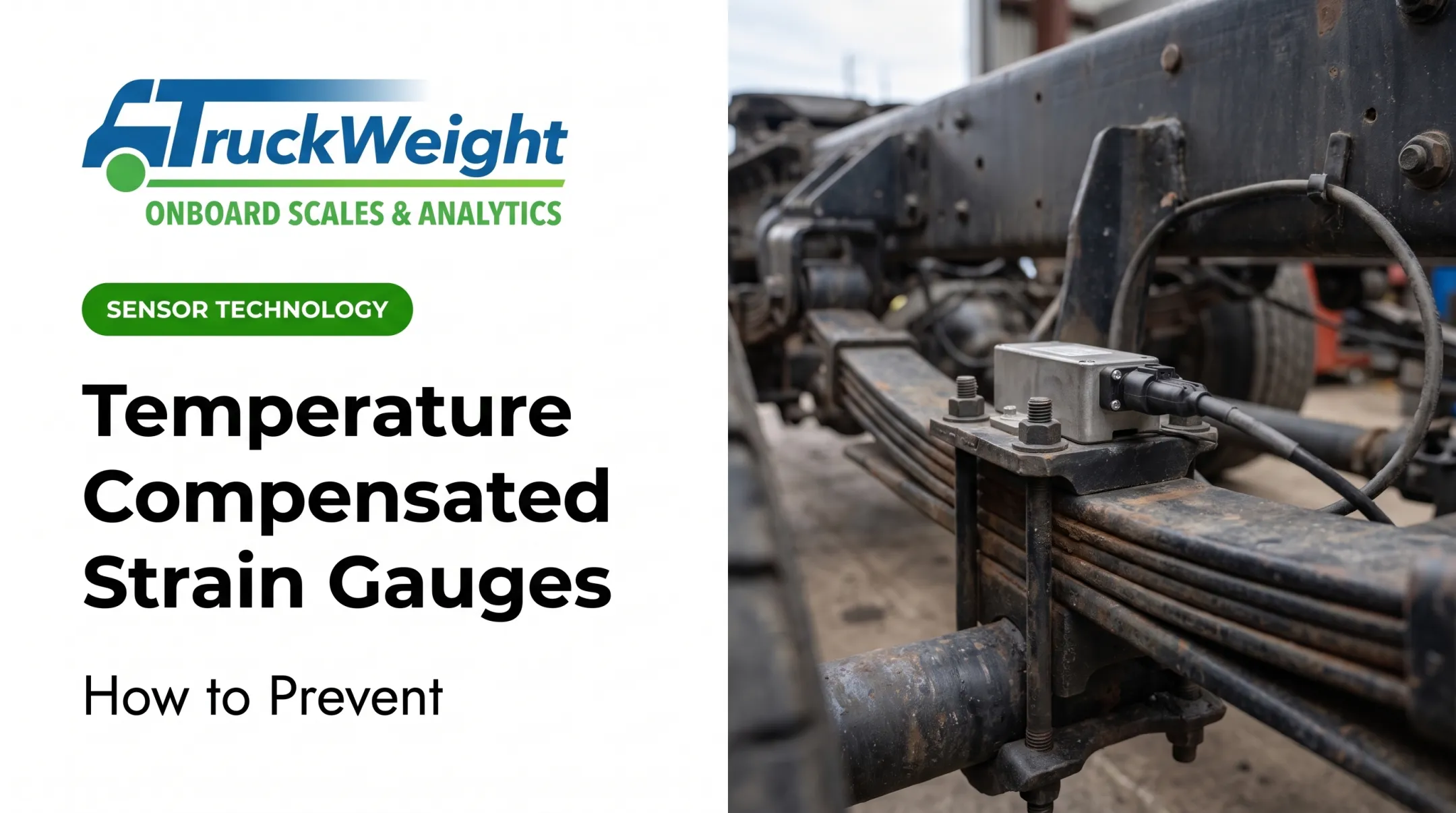
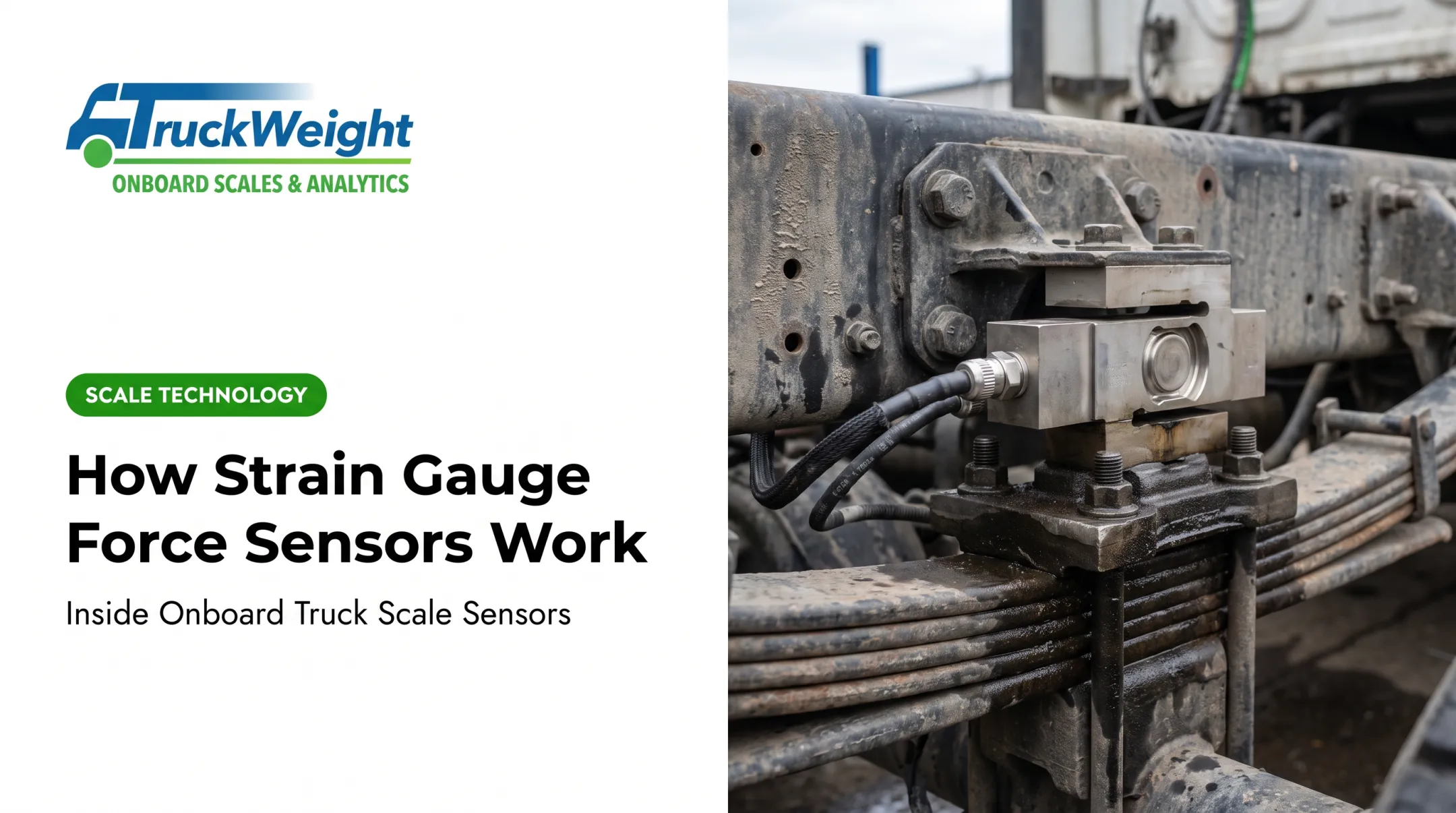
Commercial trucking operators use strain-gauge-based onboard scales, like TruckWeight's SG-1 and SG-2 sensors, to monitor axle and gross vehicle weight without stopping at external scales. That helps avoid overweight violations and improve payload efficiency on every run.
TruckWeight's SG-2, for example, is built for spring trailers, drive axles, walking-beam, and Chalmers suspensions. Accuracy is rated within 0.3% to 2% of gross vehicle weight, with wireless monitoring up to 500 feet.
Choosing the Right Bridge Configuration
Quarter bridge works when cost sensitivity matters more than precision:
- Single-point measurement
- Lower accuracy needs
- Simpler installation
Half or full bridge makes sense when:
- Higher accuracy is non-negotiable
- Temperature compensation needs to be built in, not bolted on
- The application is industrial or commercial-grade, such as vehicle scales or load cells
Rugged, field-deployed sensors used in mining, construction, or logging fleets typically favor full-bridge designs. They hold up better and stay consistent across variable temperatures.
TruckWeight's SG sensors follow that same rugged-use approach for mechanical and spring suspensions. Waterproof housings, shock resistance, corrosion-free construction, and a two-year warranty are built to survive conditions that would degrade a poorly protected sensor.
Physical protection backs up the electrical compensation stage:
- Loctite 5510 sealing over the gauge and wiring
- Watertight heat-shrink connections
- Protective split-loom cable covers
Together they keep the reading stable no matter what the truck drives through.
Conclusion
A Wheatstone bridge balances two voltage-divider halves and turns a strain gauge's resistance change into a measurable voltage. That voltage is what your system converts into a weight, pressure, or force reading.
Match the bridge type to the job—quarter, half, or full—and you get cleaner signals, simpler temperature handling, and more trustworthy readings whether you are speccing a load cell for a test bench or an onboard sensor for mining, construction, or long-haul fleets.
Frequently Asked Questions
What is the purpose of a strain gauge?
A strain gauge measures mechanical deformation by converting strain into a proportional change in electrical resistance. That resistance change is what the Wheatstone bridge detects and converts to voltage.
What are the two types of strain gauges?
Bonded (foil or wire) and unbonded strain gauges. Bonded types dominate modern applications because they're directly adhered to the test surface for accurate, stable readings.
What is a typical strain gauge?
A typical bonded foil strain gauge is a thin metallic foil pattern adhered to a test surface, with nominal resistance values commonly around 120, 350, or 1,000 ohms and a gauge factor often near 2.0.
Are strain gauges accurate?
Yes, when properly installed, compensated for temperature, and paired with an appropriate bridge configuration. TruckWeight's SG sensors, for example, are rated within 0.3% to 2% of gross vehicle weight.
Does a strain gauge use a Wheatstone bridge?
Yes. A strain gauge's resistance change is too small to measure reliably on its own, so it's wired into a Wheatstone bridge, which converts that tiny change into a readable voltage signal.
What is the difference between a full bridge and a half bridge strain gauge?
A full bridge uses four active gauges for maximum sensitivity and built-in temperature compensation. A half bridge uses two active gauges, offering moderate sensitivity at a lower installation cost.