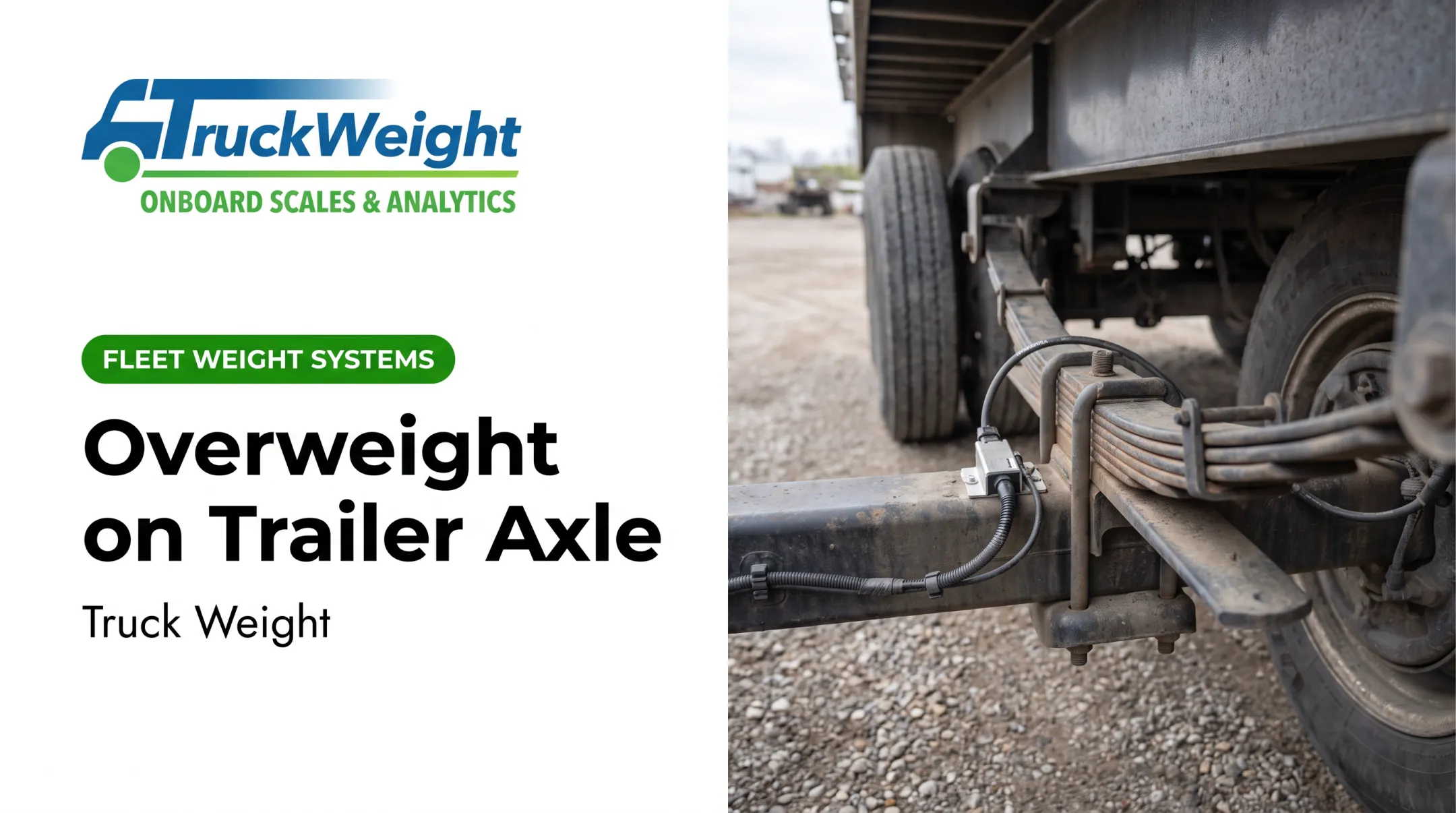

His gross weight was legal. His tandem axle was not.
This scenario plays out daily across the U.S. trucking industry. Axle load is separate from gross vehicle weight, and confusing the two is one of the most common (and costly) mistakes fleets make. This guide breaks down what axle load actually means, how it's calculated, what the legal limits are, and how to catch imbalances before they turn into fines.
Key Takeaways
- Axle load is the weight on one axle or axle group—not your truck’s total weight
- A truck can pass gross weight checks and still get cited for an overweight axle
- Federal caps are 20,000 lbs single, 34,000 lbs tandem, and 80,000 lbs gross—but state limits still vary
- Onboard scales show axle imbalances in real time so drivers can fix loads before the scale house
What Is Truck Axle Load?
Axle load is the amount of weight transmitted to the road through a single axle or axle group, whether that's a steer axle, a single rear axle, a tandem pair, or a tridem group. It's measured independently at each axle position, not calculated by dividing total weight evenly across all wheels. This is different from related terms that get confused constantly:
- GVWR (Gross Vehicle Weight Rating): The manufacturer's maximum rated loaded weight for the entire vehicle
- GVW (Gross Vehicle Weight): The vehicle's actual current weight, as measured
- Axle load: The actual weight sitting on one specific axle right now Here's the part that trips up a lot of drivers: axle load depends on cargo placement, not just total cargo weight. Two loads of identical total weight can produce very different axle readings depending on where the heaviest items sit relative to the axles. A pallet loaded six feet too far forward can push thousands of extra pounds onto the steer axle while the trailer axles sit well under capacity. More axles generally allow more total legal weight. But more axles also mean more variables to manage. Each additional axle group needs its own weight check, not just a total.
Why Axle Weight Matters for Roads
The Federal Highway Administration has found that axle-group load, axle count, spacing, and weight distribution drive pavement stress far more than gross vehicle weight alone. In one FHWA comparison, a six-axle tractor-semitrailer at 85,000 lbs produced a pavement damage index of 145-160, compared to 100 for a standard five-axle rig at 80,000 lbs, even though the heavier truck had more axles to spread the load (FHWA Western Uniformity Scenario Analysis). That's why regulators care about axle-specific limits, not just the number on your gross weight ticket.
How Is Axle Load Calculated?
Axle load is calculated from basic physics, not guesswork. Here's the simplified version fleets use to predict distribution before loading:
- Identify total load weight and its center of gravity: where does the bulk of the weight actually sit, front to back?
- Calculate the moment: multiply the load's distance from a reference point by its weight
- Divide by wheelbase: this gives you the rear axle weight
- Subtract from total weight: whatever's left is on the front/steer axle

This is standard static-equilibrium math used in commercial vehicle weight distribution planning (Work Truck Online).
A quick example:
Say a trailer carries 40,000 lbs of cargo, evenly spread. The tandem axles might read a clean 34,000 lbs, right at the federal tandem limit. Now shift that same 40,000 lbs so it's concentrated toward the rear third of the trailer. The tandem could jump past 38,000 lbs, well over the federal limit, while total gross weight hasn't changed at all.
That's the trap. Total weight tells you nothing about legality unless you also check where that weight landed.
One more rule: manufacturer axle and tire ratings (GAWR) can never be exceeded, even if the legal limit would technically allow more weight. If your axle's GAWR is 20,000 lbs but a road segment allows more, you're still capped at 20,000 lbs.
Federal and State Axle Weight Limits
The federal Interstate baseline, defined under the Bridge Formula in 23 CFR 658.17, sets these ceilings:
| Limit Type | Federal Limit |
|---|---|
| Single axle | 20,000 lbs |
| Tandem axle (40-96" spacing) | 34,000 lbs |
| Gross vehicle weight | 80,000 lbs |
But these numbers aren't universal. Each state sets its own legal and permitted limits, and drivers running multi-state routes need to check every state on their path.
Texas, for example, allows the same 20,000/34,000 lb single/tandem figures for standard legal loads, but permit holders can reach 25,000 lbs single and 46,000 lbs tandem on non-divisible loads (TxDMV Size/Weight Limits).
That points to a critical distinction:
- Legal weight: No permit required, applies to any divisible load
- Permitted weight: Requires an overweight permit, applies only to non-divisible loads (things that can't be broken into smaller shipments)
Don't assume a permit from one state or route carries over elsewhere. Always confirm axle spacing, tire capacity, and route-specific rules before dispatch.
Consequences of Exceeding Axle Load Limits
Overweight axle fines get billed even when your gross weight is fully compliant. That catches drivers off guard: passing the scale on total weight does not mean you are in the clear.
Penalty structures vary heavily by state. Minnesota's schedule, for instance, scales up based on how far over the limit you are:
- 1 cent per pound for the first 1,000 lbs over
- 5 cents per pound from 1,001-3,000 lbs over
- 10 cents per pound from 3,001-5,000 lbs over
- Up to 20 cents per pound plus $610 for anything beyond 7,000 lbs over

Liability typically lands on the driver at inspection, even though loading is often a shared responsibility between dispatch, shippers, and loaders. Build that into every loading checklist.
Beyond fines, an overloaded axle creates real operational risk:
- Overloaded steer axles reduce steering and braking control
- Tires and suspension wear faster once components exceed their rated load
- Rollover risk rises; FMCSA notes loaded vehicles with a high center of gravity can roll at lateral acceleration above 0.35 g
Gross weight alone will not catch these problems. Only axle-level checks will.
How to Monitor and Manage Axle Load Proactively
The fix isn't complicated, but it does require moving past "total weight looks fine" as your only check.
Loading best practices:
- Load heaviest items first, centered over the axles
- Secure cargo so it can't shift in transit
- Never rely solely on a gross weight estimate; check axle distribution too
Real-Time Visibility From the Cab
Onboard scale technology removes the guesswork. Drivers can see axle group, gross, and net weights before they leave the yard, instead of finding out at the next weigh station.
TruckWeight's wireless onboard scales are built for exactly this. They cover mechanical/spring suspensions with SG-1 and SG-2 strain gauge sensors (accurate to within 0.3-2% of GVW) and air-ride suspensions (accurate to within 0.3-1%).
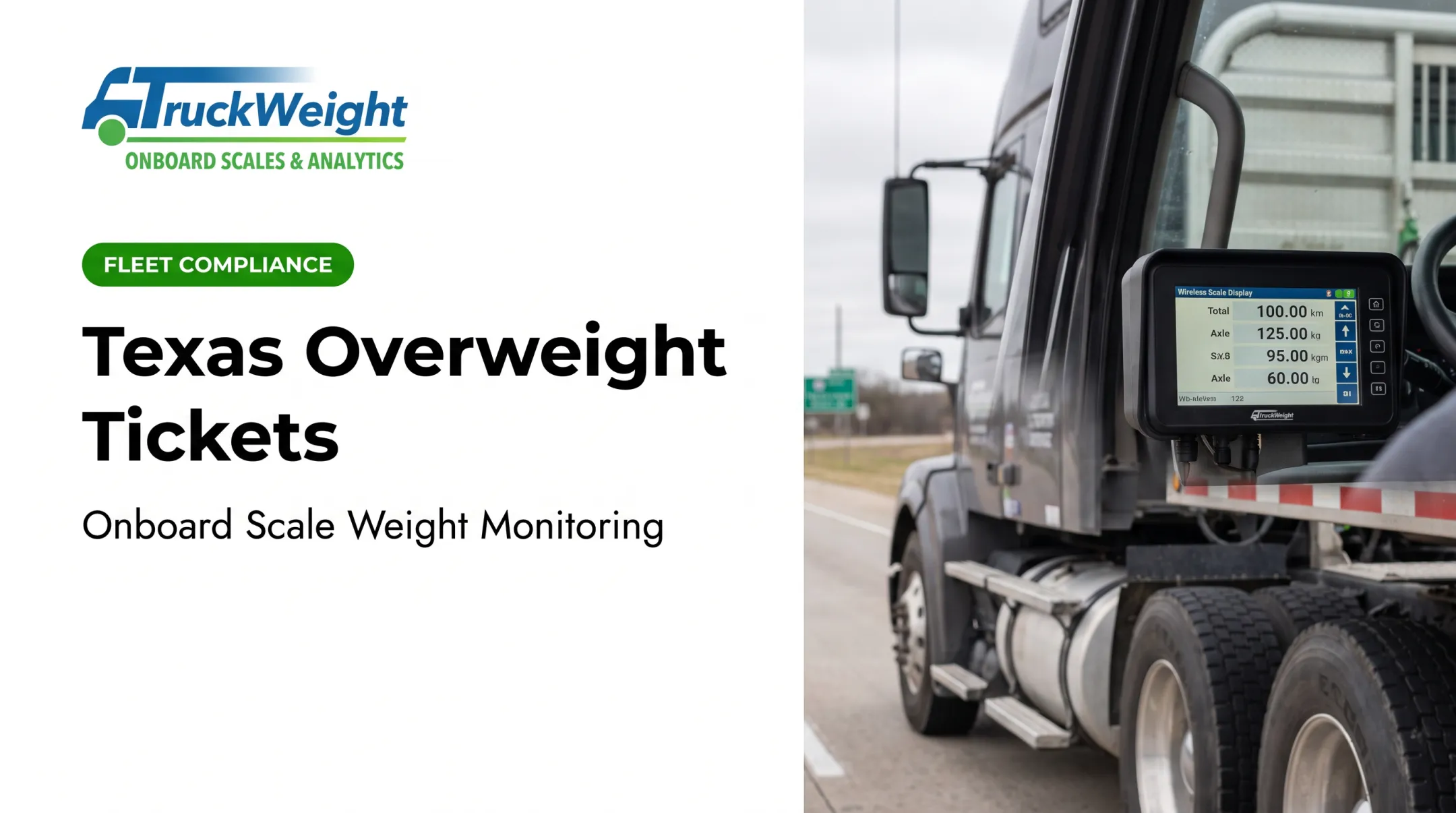
A touchscreen display in the cab shows a live breakdown, something like:
- Front Axle: 10,500 lbs
- Drives: 11,850 lbs
- Trailer: 11,900 lbs
- Total: 34,250 lbs
- Net: 1,750 lbs
Because the sensors transmit wirelessly (up to 500 feet) rather than requiring wired installation, fleets can install these systems with a standard toolkit—no electrical rebuild required.
Limar Enterprises reported that its loader operator used the handheld display to spot room for "another ton" of payload that would have gone unused. Ritcey & Sons noted that strict weight-law enforcement was cutting into margins until the Smart Scale helped them "run legal."
Fleet-Wide Tracking With TruckWeight Analytics
For fleets running multiple trucks, TruckWeight Analytics adds back-office visibility: remote sensor calibration, real-time weight-data access from any phone or computer, and automatic overweight alerts. It's built to catch loading problems before a truck ever pulls out, not after a citation shows up.
Frequently Asked Questions
How much weight can a truck axle hold?
Federal limits allow 20,000 lbs on a single axle and 34,000 lbs on a tandem axle group. States and manufacturer GAWR ratings can set lower caps, so always use the lowest limit for your truck and route.
What is an axle load?
Axle load is the actual weight carried by one axle or axle group, measured independently from the truck's total weight. A truck can be legal on gross weight and still be overweight on a specific axle.
How much weight can a 7,000 lb axle carry?
That figure is the axle's GAWR—its rated capacity, common on many trailers. You can load up to 7,000 lbs on it if tire ratings for that axle are not exceeded.
How much weight can you put on a 3,500 lb axle?
A 3,500 lb axle’s GAWR caps the load at 3,500 lbs, a rating often seen on smaller trailers. Do not exceed it even when the overall load looks light.
Can a truck be overweight on an axle even if total weight is legal?
Yes. Axle-specific limits apply independently of gross vehicle weight. Uneven loading can push one axle over its limit while the total stays under the legal maximum.