
Two terms get used interchangeably in this space, and that's a problem: load cell and strain gauge. Fleet managers shopping for onboard scales need to know the difference before they spend money on the wrong hardware.
This article breaks down what each term actually means, where they show up in commercial vehicle weighing, and how to match sensor technology to your suspension type.
Key Takeaways
- A strain gauge is a sensing element that detects deformation; a load cell is the complete, calibrated transducer built around one
- Load cells are plug-and-play systems; strain gauges require precise bonding and signal conditioning
- Spring-suspension trucks typically use strain gauge sensors; air-ride fleets typically use pressure-based sensors
- Choose based on suspension type, accuracy needs, and installation preferences—neither technology is universally better
Load Cell vs Strain Gauge: Quick Comparison
Side by side, the two technologies serve different roles in onboard weighing:
| Category | Load Cell | Strain Gauge |
|---|---|---|
| Function | Complete force-to-electrical-signal transducer | Sensor that detects deformation via resistance change |
| Composition | Metal body with bonded gauges in a Wheatstone bridge | Thin foil/wire grid bonded to a flexible backing |
| Accuracy | Pre-calibrated as a complete system | Highly sensitive, but accuracy depends on installation quality |
| Installation | Plug-and-play, minimal setup | Requires careful surface prep, bonding, and wiring |
| Typical trucking use | Air suspension sensors, crane scales, weigh-in-motion | Bonded to spring suspension components for onboard weighing |

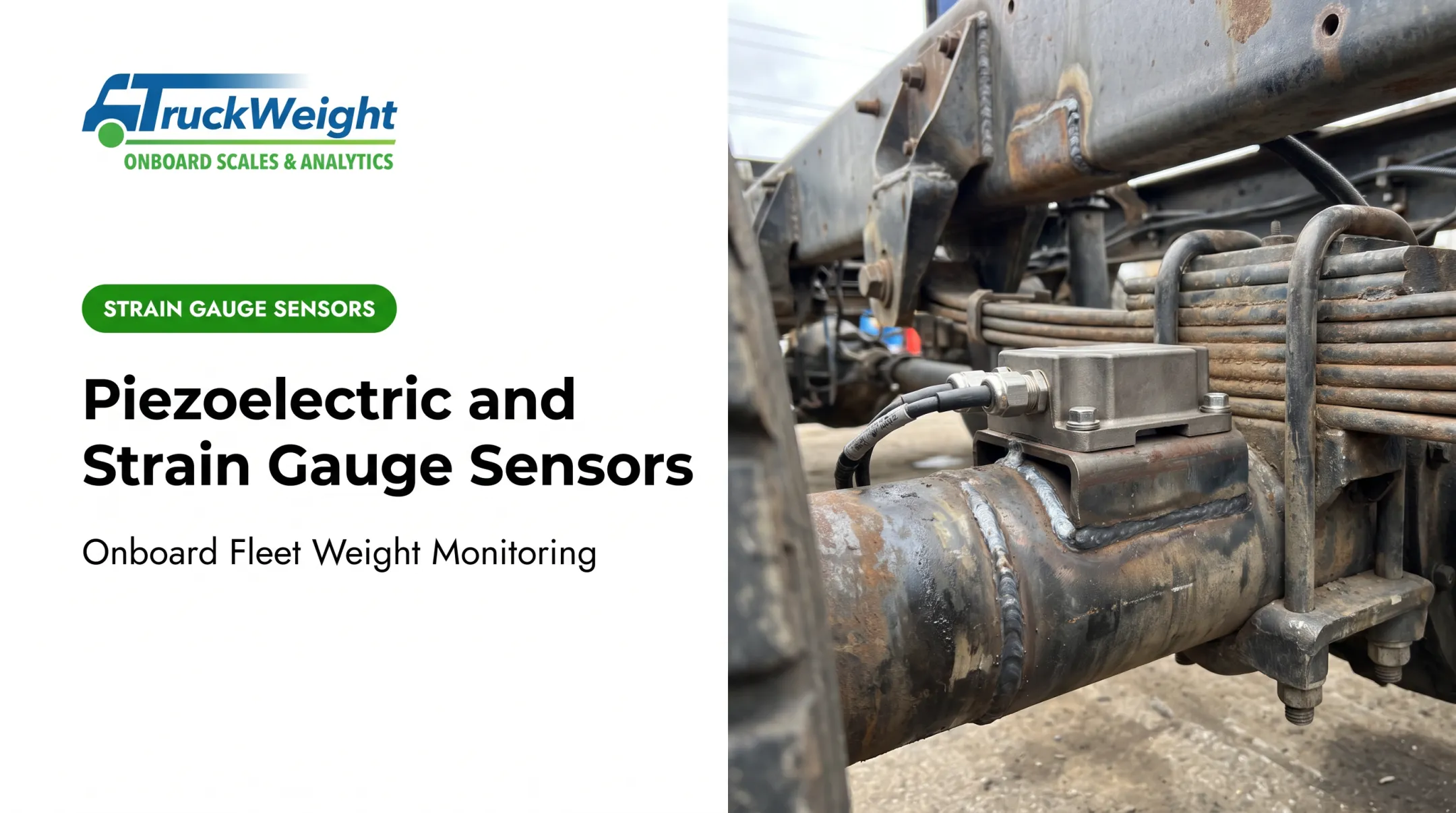
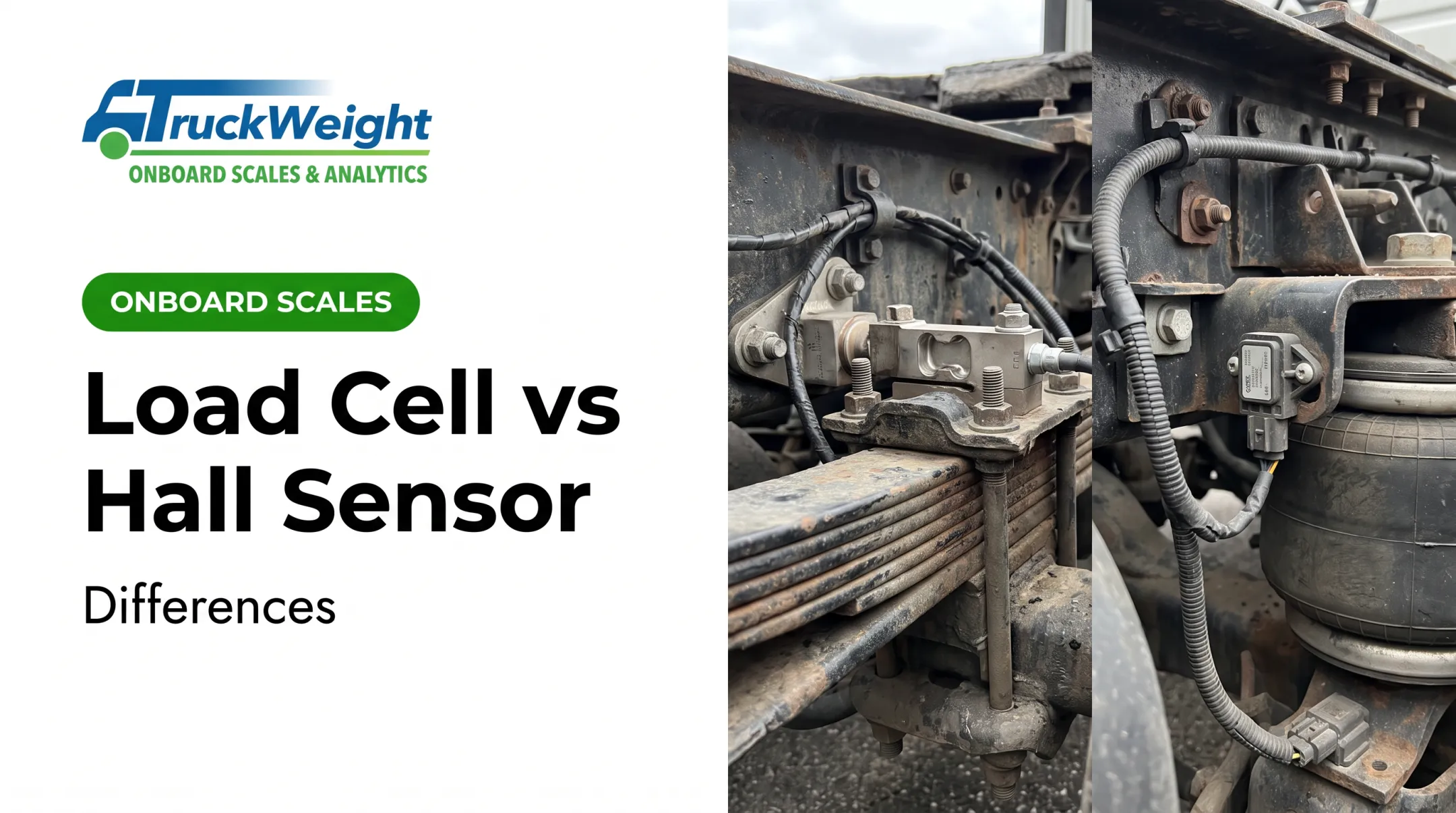
TruckWeight's product lineup illustrates this split directly. Its SG-1 and SG-2 strain gauge sensors are built for spring and mechanical suspensions, while its air suspension sensors use pressure-based load cell technology for air-ride trucks and trailers.
What Is a Strain Gauge?
A strain gauge is a sensor that measures mechanical deformation by tracking changes in electrical resistance. When a metal surface bends or stretches, the bonded gauge stretches with it, and its resistance shifts proportionally.
For spring-suspension trucks, that's useful because axle load directly affects how much a leaf spring or walking-beam component flexes. Bond a gauge to the right spot, and you get continuous axle-weight data in real time—without hauling to a certified scale or adding out-of-route trips.
Strain gauges come in a few configurations:
- Linear gauges measure strain in one direction, often axial or bending
- Shear gauges handle torque and shear strain
- Wheatstone bridge setups (quarter, half, or full-bridge) match different precision needs
TruckWeight's SG-2 sensor, for example, is built for spring trailers, drive axles, walking-beam suspensions, and Chalmers systems, with stated accuracy of 0.3%–2% of gross vehicle weight.
Where Strain Gauges Fit Mechanical Fleets
Strain gauge sensors dominate in fleets running mechanical suspensions rather than air-ride:
- Construction and demolition trucks
- Aggregate hauling (quarry-to-site runs)
- Logging and forestry equipment
- Dump trucks on spring or walking-beam axles
A 2007 log-truck study found carefully placed strain measurements on suspension components could support payload tracking. Researchers also warned that mounting location matters: the leaf spring itself was rejected due to nonlinear strain and crack risk. Installation quality determines whether a strain gauge performs well or fails quietly.
On the fleet side, a quarry hauler quoted in a 2007 Commercial Carrier Journal report on onboard scales said its onboard system kept loads within a few hundred pounds of the 80,000 lb legal limit and pushed average payload up nearly a ton.
TruckWeight customer Tri County Block & Brick saw a similar payoff on quarry runs: tighter loading precision after inexact loads had been costing extra trips.
What Is a Load Cell?
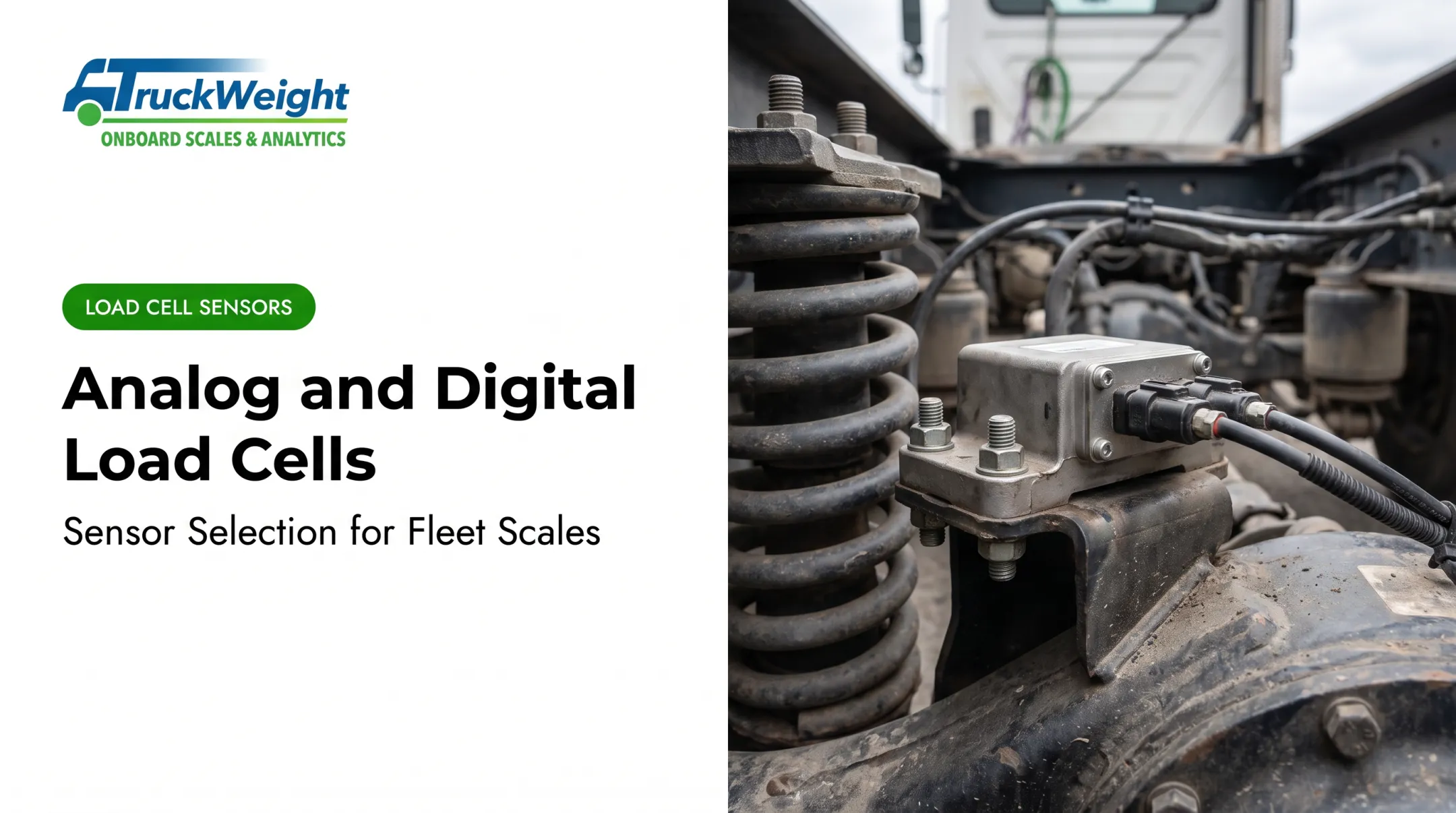
A load cell is a finished transducer: an elastic element, bonded strain gauges, and the electronics that output a calibrated force or weight reading. Where a bare strain gauge is a component, a load cell is a tested, ready-to-use system.
Core benefits:
- Durability across varying operating conditions
- Easier integration — no field bonding required
- Factory-calibrated output for consistent, repeatable readings
Common load cell configurations include:
- Compression — measures pushing force
- Tension — measures pulling force
- Shear beam — side-load design common in platform and tank weighing
- S-type — compact tension/compression form factor for hanging or inline loads
- Air suspension sensors — pressure-based, purpose-built for air-ride trucks
Use Cases of Load Cells
Load cells and pressure-based load cell sensors show up wherever a system needs a self-contained, calibrated reading:
- Crane scales and weigh stations
- Air suspension onboard scale systems
- Heavy off-road mining trucks
- Material handling and aerospace applications
TruckWeight's patented air suspension sensor measures suspension air pressure and temperature to calculate axle and gross vehicle weight. Stated accuracy is 0.3%–1% in all weather conditions.
It fits heavy off-road mining trucks, refuse and steel haulers, and agriculture, asphalt, and bulk-material fleets on air-ride suspensions.
TruckWeight's air suspension sensor installs through a T-fitting spliced into the airline between airbags, with the locking nut torqued to about 20 ft-lb. No bonding, drying time, or surface prep is required.
Strain Gauge vs Load Cell: Which Is Right for Your Fleet?
Strain Gauge vs Air Suspension Sensor: Which Is Right for Your Fleet?
The decision comes down to four factors:
- Suspension type — spring/mechanical vs. air-ride
- Required accuracy — how tight a margin your operation needs
- Installation complexity — bonding work vs. plug-and-use
- Operating environment — exposure, vibration, corrosion risk
Match the sensor to the suspension first:
Spring-suspension trucks and trailers (cost-effective retrofit):
- TruckWeight SG-1 ($699) for front axles; SG-2 ($799) for drive axles, walking-beam, and Chalmers
- Stated accuracy: 0.3%–2% of GVW
Air-ride fleets (tighter stated accuracy):
- TruckWeight air suspension sensor ($499)
- Stated accuracy: 0.3%–1% in all weather
Both options share a 500-foot (155-meter) wireless range and install without special tools. They are built for different suspension architectures.

Mixed fleets can run strain gauges on spring front axles and air sensors on air-ride drive axles on the same truck.
Real-World Example: Choosing the Right Sensor for Fleet Compliance
Picture an aggregate hauling operation running seven quarry-to-site loads a day. Loading was done by eye, without a reliable in-yard weight check. The result: some loads ran overweight and triggered fines, while others left underloaded, quietly eating into daily payload capacity.
TruckWeight customer Tri County Block & Brick faced the same problem. Inexact weight measurement in the loading area was costing the company trips: a direct hit to productivity when your business depends on hitting a daily load count.
The fix was a wireless onboard scale matched to each truck's suspension type:
- Spring suspension: SG strain gauge sensor bonded to the axle or walking-beam
- Air-ride: pressure-based air suspension sensor
After installation, Tri County reported more precise loading and fewer lost trips tied to weight guesswork.
The takeaway: Matching sensor technology to suspension type directly affects how many loads a truck completes per day and whether those loads hold up at the scale house.
If your fleet is losing payload efficiency to guesswork, explore TruckWeight's onboard scale solutions to find the sensor built for your suspension setup.
Conclusion
Strain gauges and load cells are complementary. One is a sensing component; the other is the finished, calibrated system built around it. For commercial trucking, the right choice comes down to suspension type: strain gauge sensors for spring and mechanical suspensions, and pressure-based load cell sensors for air-ride setups.
Match the sensor to the suspension, and fleets gain better payload optimization, stronger regulatory compliance, and fewer trucks pulled for overweight violations.
Frequently Asked Questions
Are strain gauge load cells accurate?
Yes, when properly calibrated and installed. TruckWeight's SG-2 strain gauge sensor, for example, is rated at 0.3%–2% of gross vehicle weight, while its air suspension sensor reaches 0.3%–1%.
What is the difference between a strain gauge and a load cell?
A strain gauge is a sensing component that detects deformation. A load cell is the complete, calibrated transducer assembly (a structural element plus bonded gauges plus electronics) built around that sensing technology.
Do load cells use strain gauges?
Many common electronic load cells do use bonded strain gauges as their sensing element, though not every load cell relies on this method. Some use pressure or piezoelectric technology instead.
How does a strain gauge load cell work?
Force applied to the load cell's structural element causes it to deform slightly. That deformation changes the strain gauge's electrical resistance, which is measured through a Wheatstone bridge circuit and converted into a proportional voltage signal.
What are the four types of load cells?
Common types include compression (measures pushing force), tension (measures pulling force), shear beam (handles both), and S-type or bending-beam configurations used in various weighing applications.
What are the two types of strain gauges?
Linear gauges measure strain in one direction, typically axial or bending forces. Shear gauges are designed to measure shear strain and torque, with a different wire orientation than linear designs.