
A 2008 NCHRP report put the national cost of overweight truck travel at $265 million to $1.11 billion annually in added roadway costs. That's the price of drift multiplied across an entire industry.
This guide walks through load cell types used in trucking, how calibration actually works, how often to do it, and practical steps to keep your onboard scales honest between certified checks.
Key Takeaways
- Load cells drift from wear, temperature swings, and mechanical stress — calibration isn't optional maintenance
- Two-point calibration is fast; multipoint calibration corrects non-linearity across the full weight range
- Annual recalibration is the general baseline; harsh-duty fleets need more frequent checks
- Self-installable rugged sensors cut installation errors and calibration downtime
What Are Load Cells and What Types Are Used in Trucking?
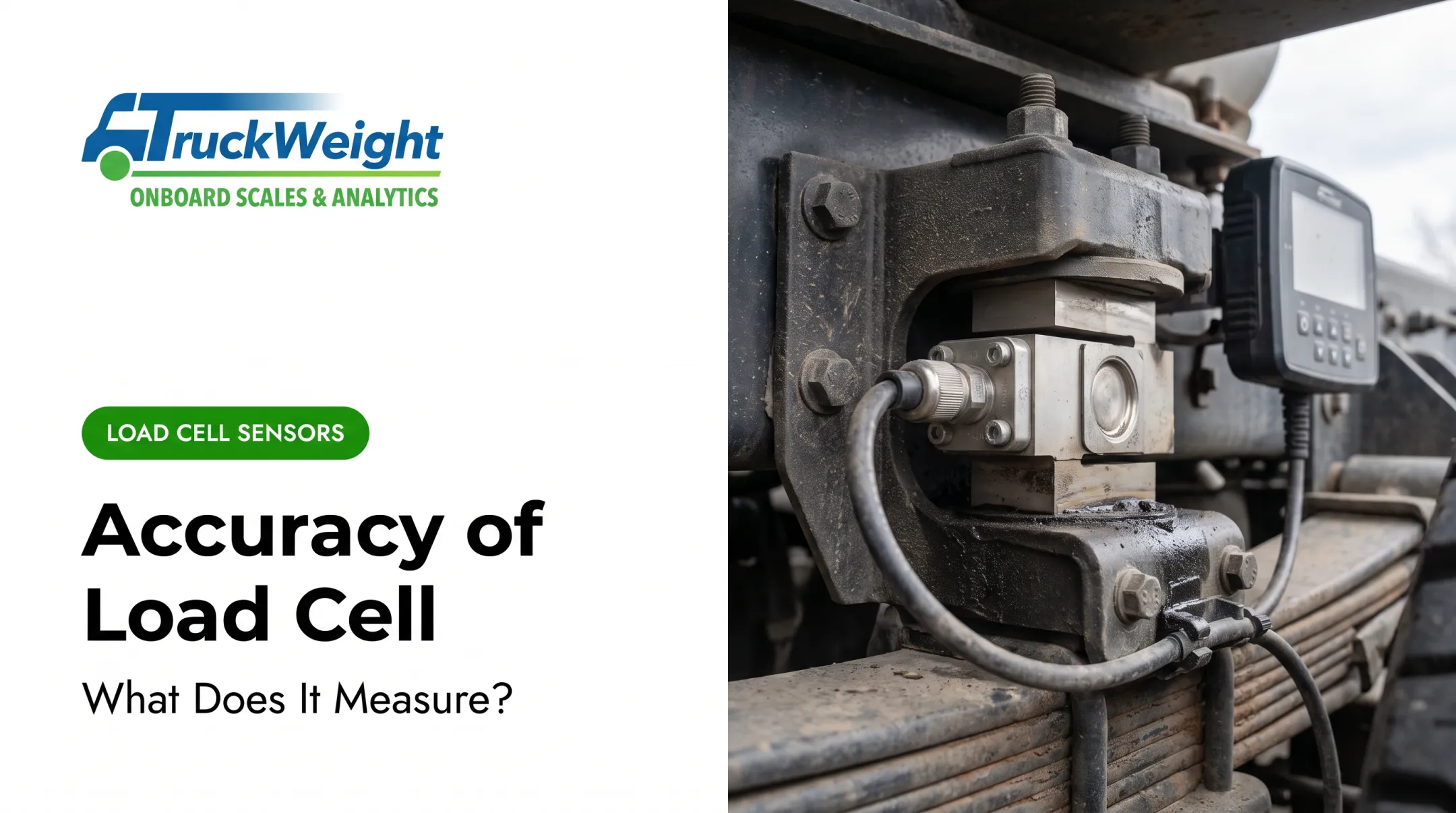
A load cell is a transducer that converts mechanical force into an electrical signal. Most onboard truck scales rely on strain gauge technology: a deformable metal body with gauges that change resistance under load, producing a voltage proportional to the weight applied.
Main Types of Load Cells
Strain gauge load cells are the workhorse for spring and mechanical suspensions. They mount directly on the axle and read deflection as weight.
Air suspension sensors serve air-ride tractors and trailers differently. Instead of measuring deflection, they read air-spring pressure and convert it to weight. TruckWeight's patented air suspension sensor technology is rated for 0.3%–1% accuracy across weather conditions, calculating weight from both temperature and pressure changes in the suspension.
Outside trucking, you'll also find:
- Hydraulic load cells (industrial vats, tanks)
- Pneumatic load cells (explosive-environment applications)
- Capacitive load cells (lab-grade precision instruments)
These rarely appear in fleet weighing.
For fleet-specific hardware, TruckWeight's lineup includes:
- SG-1 and SG-2 strain gauges for spring, walking-beam, and Chalmers suspensions
- MG-3 military-grade sensor with zero wear and minimal maintenance in rugged, high-cycle environments like refuse and mining
Why Load Cell Calibration Matters for Fleet Operations
An uncalibrated load cell costs real money in three ways:
- Overweight fines from relying on a reading that's crept off true
- Wasted payload capacity when drivers underload out of caution
- Out-of-route trips to certified scales because nobody trusts the onboard reading anymore
Continuously operated weigh stations on the U.S. Interstate System capture only about 1% of overweight violations. Most overweight trucks never get caught at a station, but they still carry legal and safety risk every mile they run heavy. FHWA/DOT enforcement data tracks these violations at the state level.
Calibration drift also erodes something harder to fix than a fine: driver trust. Once an onboard reading disagrees with a certified scale a few times, drivers stop believing the dashboard entirely and go back to guessing.
How to Calibrate a Load Cell
The core procedure is the same whether you're working with a strain gauge or an air suspension sensor:
- Apply known reference loads. Weigh the vehicle empty, then loaded, on a certified ground scale.
- Compare output readings against the expected values from those certified weights.
- Adjust internal settings or offsets to correct any deviation between sensor output and true weight.
- Document everything: dates, readings, and technician notes for your maintenance records.

For air suspension sensors specifically, a few extra steps matter:
- Dump and refill the airbags
- Let the suspension settle
- Keep the air brakes off during measurement (brake torque skews pressure readings)
A pressure difference greater than 0.3 PSI between sides often signals an unlevel surface rather than an actual weight discrepancy.
Two-Point vs. Multipoint Calibration
Two-point calibration uses two references — typically empty and near-max load — to draw a straight line between them. It's fast and sufficient for most routine fleet checks.
Multipoint calibration takes readings at several load steps across the full capacity range. It catches non-linearity that a two-point method misses, which matters more for fleets running variable loads or needing tighter tolerances.
Industry procedures like ASTM E74 and ISO 376 use this approach in lab settings, often with 8-10 load steps and multiple orientation checks. That level of rigor exceeds most day-to-day fleet needs, but the same logic still applies: more data points improve accuracy on fleet-level multipoint checks.

How Often Should a Load Cell Be Calibrated?
Annual calibration is the general industry baseline for most fleet load cells. No manufacturer manual states a single universal interval. The real answer depends on how hard you're running the equipment.
Recalibrate more often if you're operating in:
- Mining, construction, or off-road environments
- Heavy daily-use cycles with constant load changes
- Extreme temperature swings between seasons
Watch for these warning signs that calibration is overdue:
- Shifted zero balance (the scale reads something other than zero when empty)
- Inconsistent readings under the same known load
- Repeated overweight citations despite onboard readings showing legal weight
If any of these show up, don't wait for the annual mark. Recalibrate immediately.
Improving Load Cell Accuracy and Reducing Calibration Issues
Most calibration headaches trace back to installation and environment, not the sensor itself.
Inspect regularly. Check cables for chafing, corrosion at connection points, and physical wear from road debris. Catching a frayed cable early beats troubleshooting a mystery drift later.
Protect against the elements. Weatherproof, shock-resistant housings matter for fleets running dust, moisture, and vibration daily. TruckWeight's onboard systems are built waterproof and non-corrosive for these conditions.
Install it right the first time.
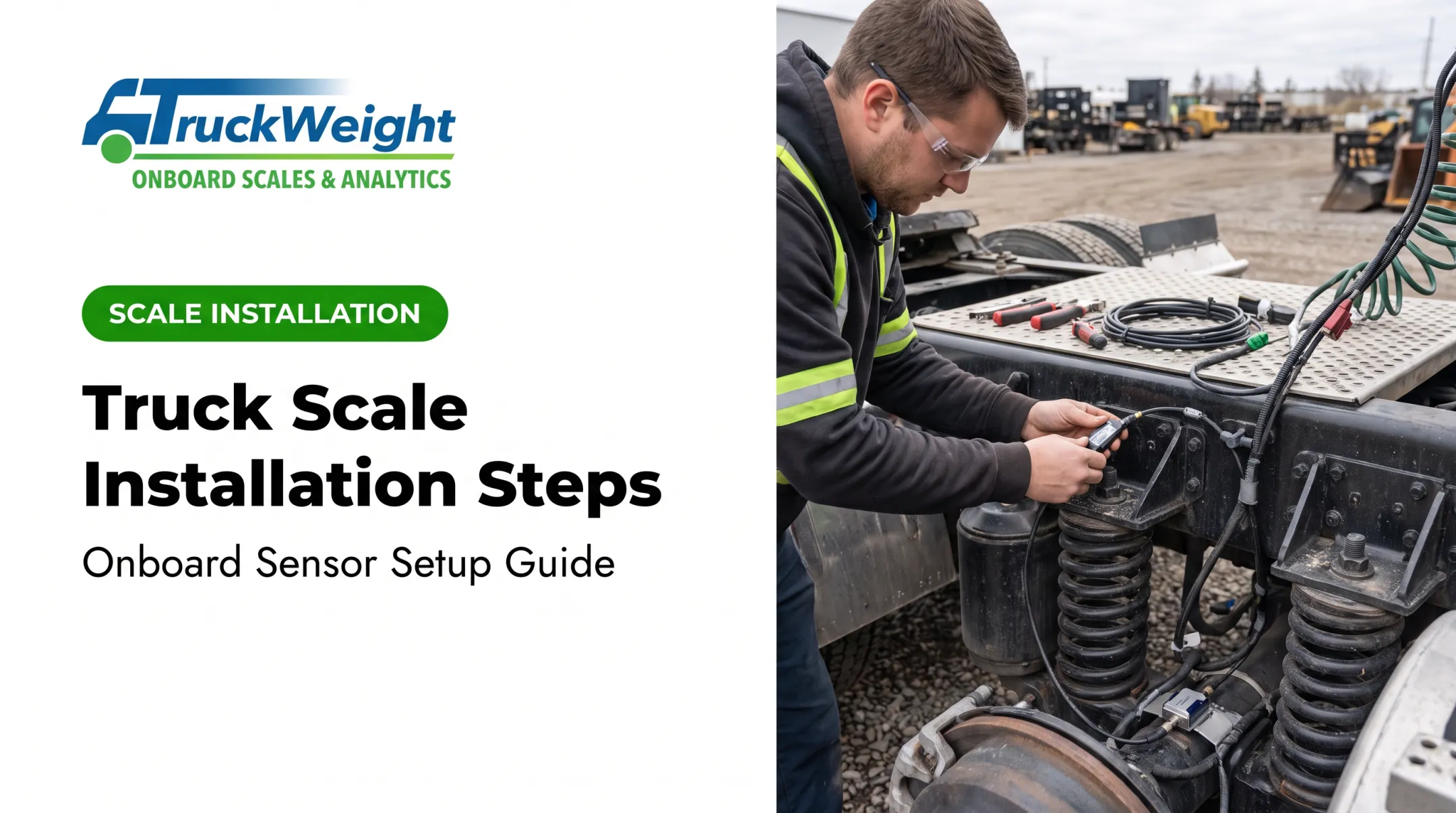
- Mount strain gauges on top of the axle, not on the spring
- Route cables along the protected backside of the axle — never between the spring and spring-stop pad
- Use ¼-inch high-temperature split-loom conduit to prevent chafing
- Leave slack in the harness and secure with tie-wraps

Log everything digitally. Track calibration dates and drift trends over time instead of relying on memory or paper logs. TruckWeight Analytics supports this with remote sensor calibration and cloud configuration, so back-office teams can flag equipment that needs attention across the fleet.
In-house vs. outsourced calibration:
| Factor | In-House | Outsourced |
|---|---|---|
| Cost | Lower per-check | Higher per-visit |
| Control | Full scheduling control | Dependent on provider availability |
| Equipment | Requires certified ground scale access | Provider supplies calibration tools |
| Traceability | Manual documentation | Often built into service records |
Many fleets land on a hybrid: routine in-house checks using a certified scale, with remote calibration services handling configuration and verification between physical visits.
Frequently Asked Questions
How is a load cell calibrated?
You apply known reference loads (empty and loaded weights from a certified scale) and compare the sensor's output to those values. Then adjust internal offsets to correct any deviation and document the results.
How often should a load cell be calibrated?
Annual calibration is the general standard for most fleets. Harsh environments like mining or construction, or heavy daily use, call for more frequent checks.
Do load cells need to be calibrated?
Yes. Wear, temperature swings, and mechanical stress cause drift over time, which makes periodic recalibration necessary to keep readings accurate.
How can I improve load cell accuracy?
Inspect cables and mounts regularly, use protective housings in harsh conditions, follow proper installation practices, and keep a consistent calibration schedule.
What are the types of load cell calibration?
Two-point calibration uses empty and full readings for a quick line fit. Multipoint calibration uses several load steps across the full range for better accuracy and non-linearity correction.
What are the main types of load cells?
Common types include strain gauge load cells for spring and mechanical suspensions, air suspension sensors for air-ride setups, and hydraulic, pneumatic, or capacitive cells used mainly outside trucking.