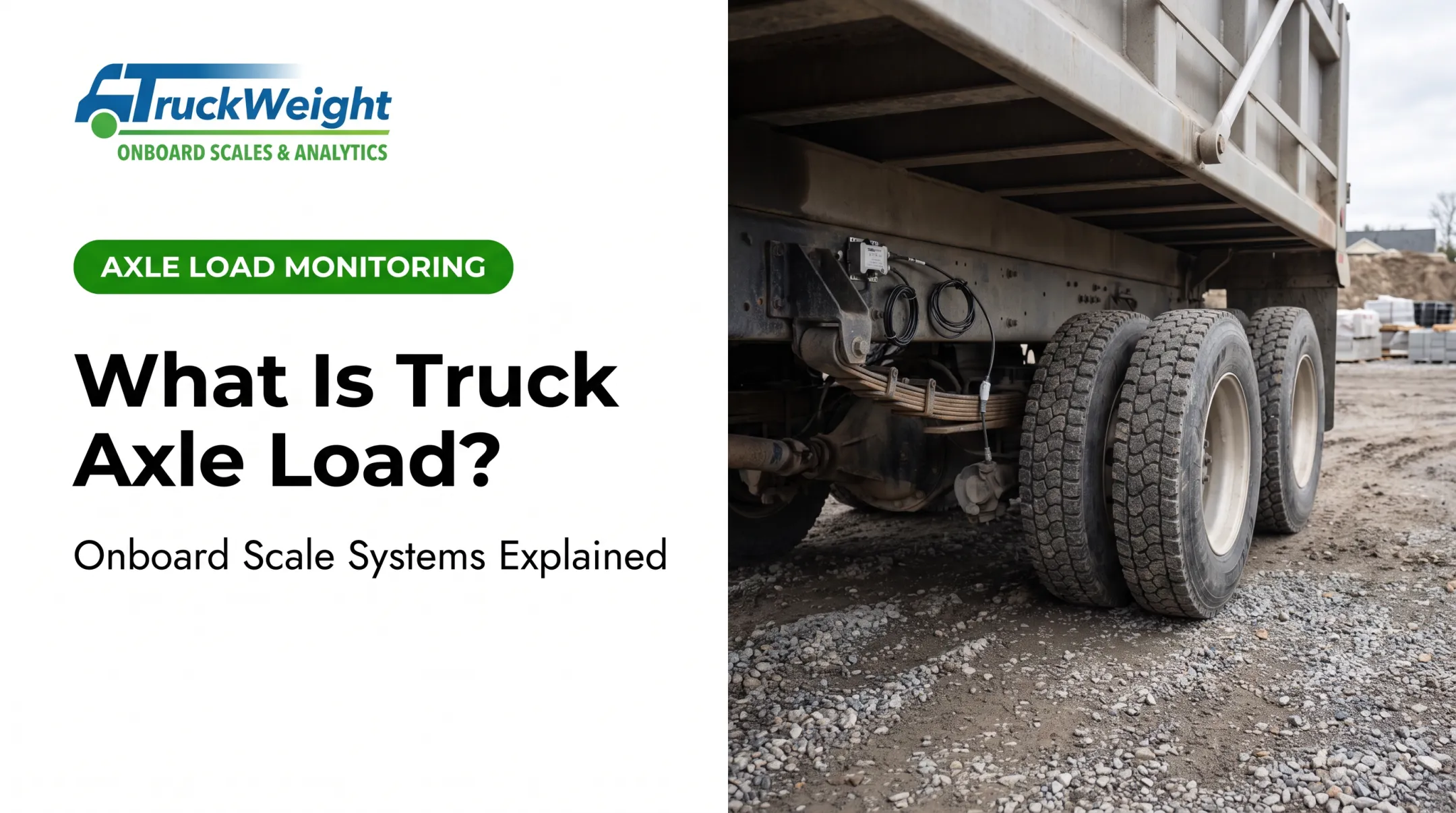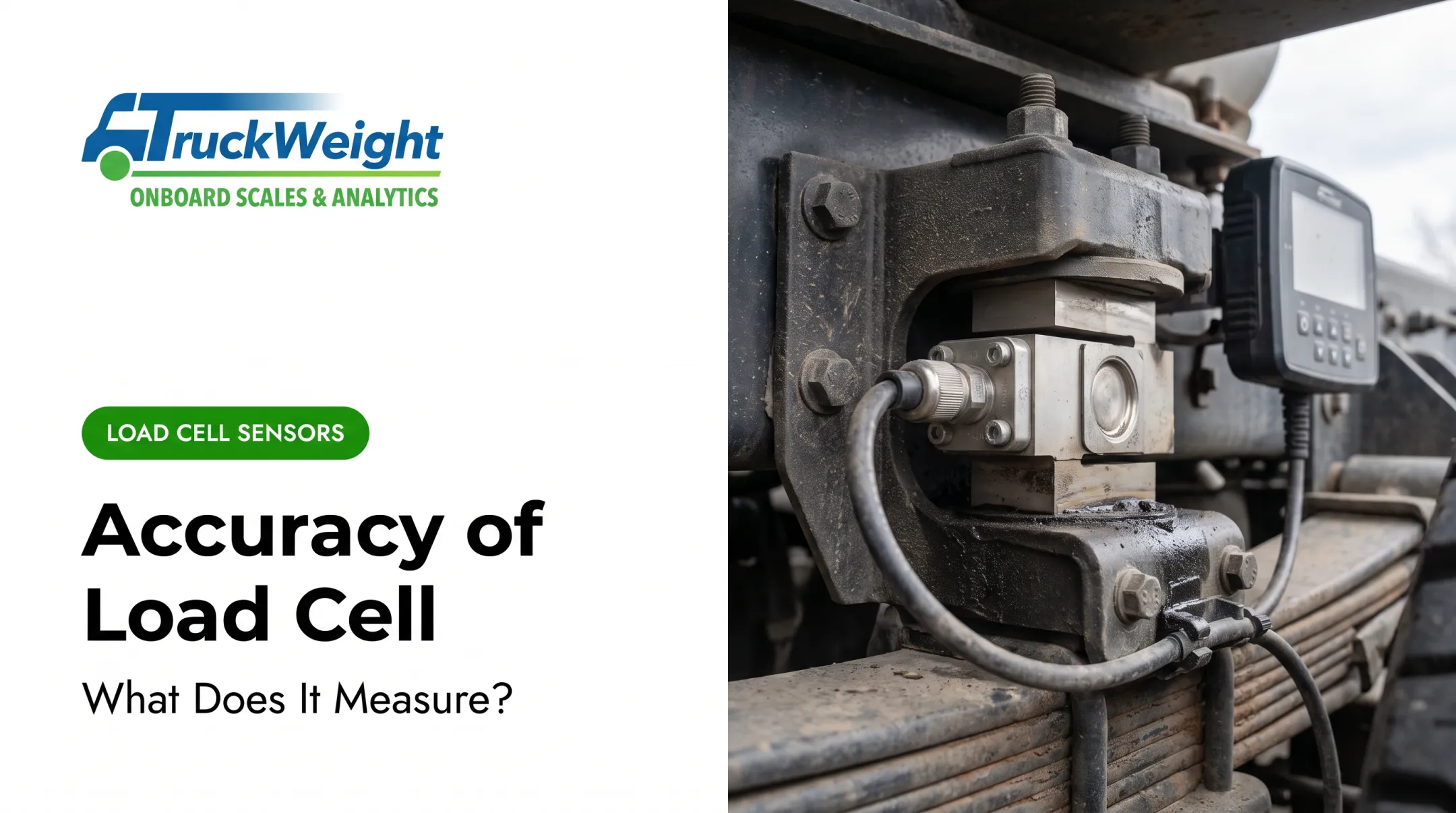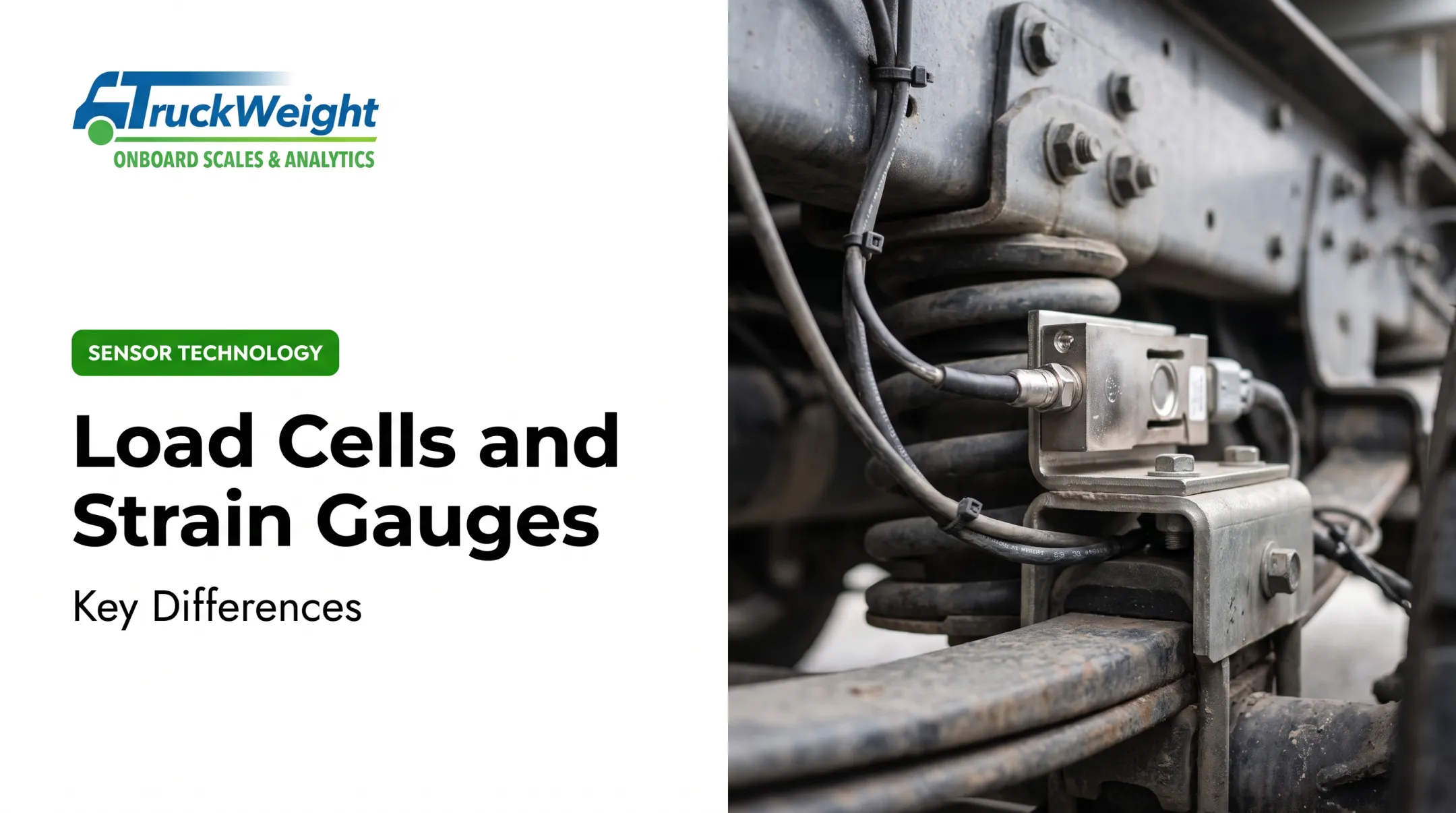

There's no reliable national average for what an overweight ticket costs since fines vary by state, county, and how far over you are. Oregon, for example, charges anywhere from $100 for being under 1,000 lbs over to $0.24 per pound once you're past 12,500 lbs over Oregon Revised Statutes. That's the kind of unpredictability suspension load gauges exist to prevent.
This guide covers how these gauges work, how to read them, PSI benchmarks, accuracy differences, and how to pick the right system for your fleet.
Key Takeaways
- Suspension load gauges estimate axle and gross weight from air pressure or strain readings—no scale trip required.
- Accuracy varies widely: basic needle gauges give rough checks; digital/wireless onboard systems read far tighter.
- Air suspension gauges are not legal-for-trade; use certified scales for weight-based billing or disputes.
- Wireless strain gauge and air sensor systems cut out-of-route scale trips and lower overweight violation risk.
What Is a Suspension Load Gauge and How Does It Work?
A suspension load gauge reads pressure or deformation in your suspension and converts that into an estimated axle or gross weight. It's a screening tool, not a courtroom-ready measurement. There are two core technologies:
- Air pressure gauges — used on air-ride suspensions. As load increases, the air spring compresses and PSI rises.
- Strain gauges — used on mechanical/spring or walking-beam suspensions. These measure physical deformation in suspension components and convert resistance changes into a load value. Hendrickson's technical documentation explains that a height-control valve adds or exhausts air to maintain ride height as load changes, so pressure tracks load. That relationship is suspension-specific, not universal (Hendrickson technical procedure). One manufacturer's chart shows 20 PSI equaling 2,000 lbs and 120 PSI equaling 13,200 lbs on a specific model: roughly 100 lbs per PSI, not the "480 lbs per PSI" figure sometimes repeated online. Treat any generic PSI-to-weight ratio as a rough estimate until you calibrate your specific truck. Because pressure curves and spring deflection vary by suspension, sensor design matters as much as the readout. Modern onboard systems cover both air-ride and mechanical setups:
- Air suspension sensors calculate weight from temperature and pressure together, which helps correct weather-driven PSI shifts
- SG-1 / SG-2 strain gauges cover front axles, drives, trailers, walking-beam, and Chalmers mechanical suspensions TruckWeight's patented air sensor and SG-series gauges follow that split: air-ride on one path, spring and walking-beam on the other. Whatever technology you run, calibration against a certified scale is non-negotiable:
- Match the gauge to a known axle or gross weight on a certified scale
- Recheck after suspension work, major temperature swings, or sensor replacement Without that reference point, you're only reading a number.

How to Read a Suspension Load Gauge (Step-by-Step)
Reading a gauge correctly starts long before you look at the dial.
Calibrate First
- Drive to a certified scale empty. Record the axle-group weight and the corresponding gauge reading.
- Load close to legal maximum and weigh again. Record that second reading.
- Build a reference curve between those two points for each axle group.
Manufacturer guidance typically calls for brakes released, airbags fully inflated, and the same level scale for both readings so results stay consistent.

Reading a Needle Gauge
Locate the gauge on the dash or frame, read the PSI, and compare it against your calibrated reference point, not a generic chart.
Some drivers "max out" a load once to find a baseline PSI, then treat any lower reading as presumed legal. That works, but only if the baseline was itself weighed on a certified scale.
Watch the increments. A needle gauge that reads in 5 PSI jumps can create weight estimation errors of over 1,000 lbs, simply because you're rounding between lines on the dial.
Reading a Digital/Wireless Display
Digital systems skip the PSI-to-weight math entirely. TruckWeight's long-range touchscreen display, for example, shows:
- Truck ID
- Front axle weight
- Drive axle weight
- Trailer weight
- Total gross weight
- Net weight
No conversion required. The sensor does it for you.
What PSI Should I Run in My Air Suspension?
There's no single "correct" PSI number. It depends on your suspension model, GVWR, and manufacturer specs.
Manufacturer load charts make that clear. One Reyco suspension model runs a 95-125 PSI ride pressure range, while another model's chart spans 20-120 PSI depending on axle load. Those numbers aren't interchangeable across suspensions.
Pull the suspension manufacturer's load/PSI chart for your exact model and axle configuration. That chart—not a generic blog range—is your authoritative reference.
Tag Axles Are Different
Tag axle air pressure is usually adjustable on purpose. Operators use it to shift weight distribution between axles rather than hold a fixed ride height. TruckWeight's documented calibration process for regulator-controlled lift axles looks like this:
- Position the loaded trailer so only the lift axle's weight registers on the scale
- Apply 20-25 PSI, record the scale weight and handheld PSI as your empty setting
- Increase to 40-45 PSI, record the scale weight and handheld PSI as your loaded setting
Drive and tandem-axle sensors should be calibrated with lift axles raised, since a tag axle in the down position changes weight distribution across the whole rig.

Accuracy: Why Not All Suspension Load Gauges Are Equal
Not all gauges deliver the same accuracy, and the gap is bigger than most drivers assume.
| Gauge Type | Typical Accuracy |
|---|---|
| Basic needle gauge (5 PSI increments) | Errors of 1,000-2,000+ lbs |
| High-resolution digital pressure sensor | Within roughly 80 lbs on fine readings |
| Air-Weigh air-ride system | ±300 lbs per axle group |
| TruckWeight air suspension sensor | 0.3%-1% (manufacturer claim) |
| TruckWeight SG strain gauge sensors | 0.3%-2% of gross vehicle weight |

TruckWeight's 0.3% to 1% figure is a published product specification, not an independently audited benchmark—worth knowing if you're comparing vendor claims.
An independent USDA Forest Service field study on in-woods logging trucks found sensor accuracy varied significantly by axle position. Tandem-drive sensors matched certified references closely, while trailer sensors showed larger swings.
Percentage claims matter less than how well the system was calibrated on your specific rig.
Strain gauge systems for spring suspensions need the same calibration rigor as air systems. Mechanical suspensions don't have a clean pressure-to-weight relationship the way air springs do, so skipping calibration here is even riskier.
Limitations: What Suspension Load Gauges Can't Do
Suspension load gauges are advisory tools. They have clear limits:
- Not legal-for-trade. NIST Handbook 44 requires certified equipment for official weight-based billing or enforcement. Standard onboard gauges don't qualify—use certified scales for citations or payment disputes.
- Drift happens. Readings shift as suspensions wear or parts are replaced. TruckWeight guidance: recalibrate after air-suspension component changes to hold accuracy.
- Mixed fleets complicate training. Each truck/trailer combo has its own calibration curve, so drivers need rig-specific reference points—not one fleet-wide number.
Choosing an Onboard Scale System Over a Basic Gauge
For fleets hauling aggregate, refuse, construction materials, or other bulk loads, a basic needle gauge often isn't precise enough. The margin for error adds up fast when you're running near GVWR daily.
Selection Criteria
- Wireless vs. wired installation — wireless setups skip complex cabling
- Suspension compatibility — confirm the system supports air-ride, mechanical/spring, or walking-beam configurations
- Display readability — clear axle-group, gross, and net weight readouts beat needle-and-conversion setups
- Data and reporting — centralized weight data helps with compliance records and dispatch decisions TruckWeight's wireless lineup covers this range:
- SG-1 and SG-2 strain gauges for spring and mechanical axles
- Patented air suspension sensors for air-ride setups
- MG-3 military-grade sensors with a zero wear-and-tear durability claim Both the SG and air sensor systems are built for self-installation. The SG kit uses a grinder, sandpaper, and super glue rather than specialized tools, and install typically takes minutes. For multi-truck fleets, TruckWeight Analytics centralizes weight data with real-time monitoring, remote calibration, overweight alerts, and cloud/telematics API integration. Tri County Block & Brick runs seven sand-and-stone loads daily from a nearby quarry. After losing trips to bad measurements, the fleet used the system to tighten loading precision—an everyday risk for aggregate haulers working thin margins on every load.
Frequently Asked Questions
How do you read a suspension load gauge?
Calibrate it first by weighing empty and loaded on a certified scale, then compare live PSI or digital readouts to that baseline. Never trust a gauge reading without a calibration reference behind it.
What PSI should I run in my air suspension?
It depends on your suspension's make, model, and GVWR; there's no universal number. Check the manufacturer's load/PSI chart for your exact suspension model.
How much air pressure should be in a tag axle?
Tag axle PSI is adjustable and used to redistribute weight between axles, so it should follow the axle manufacturer's specified range. Calibrate it separately from your drive and trailer axles.
What is a suspension load gauge?
It's a device that estimates axle or gross vehicle weight by reading suspension air pressure or mechanical strain. It's a screening tool for load management, not a certified measurement.
Are suspension load gauges accurate enough to avoid overweight tickets?
Accuracy varies widely by gauge type. Basic needle gauges can be off by thousands of pounds, while calibrated digital or onboard scale systems are far more reliable for staying legal.
How often should a suspension load gauge be recalibrated?
There's no fixed calendar schedule. Recalibrate after suspension repairs, component changes, or whenever readings drift from known scale weights.