
Choosing the wrong one isn't just an engineering mistake. For fleet operators, it affects weighing accuracy, compliance with axle weight regulations, and long-term maintenance costs. Get it wrong, and you're looking at overweight fines or unreliable data at the worst possible time.
This article breaks down how each sensor works, where each one excels, and how to pick the right technology for onboard truck scale applications.
Key Takeaways
- Load cells measure force/weight directly through strain gauge deformation
- Hall sensors detect position/proximity using magnetic fields, not weight
- Higher upfront cost buys load-cell accuracy fleets need for compliance
- Cheaper Hall sensors stay contactless and durable but can't weigh anything
- Choose based on whether you need to know "how much" or "where"
Load Cell vs Hall Sensor: Quick Comparison
Here's how these two sensor types stack up across cost, accuracy, and best-fit applications:
| Factor | Load Cell | Hall Sensor |
|---|---|---|
| Cost | Higher (roughly $499-$799 per unit for onboard truck scale sensors) | Lower, IC-based pricing |
| Measurement Principle | Strain gauge deformation under force | Magnetic field/flux detection |
| Accuracy for Weight | Designed specifically for this; 0.3%-2% of GVW achievable | Cannot measure weight directly |
| Durability | Depends on mounting, overload protection, and installation | Contactless design avoids wear from sensing contact |
| Best Use Case | Onboard truck scales, axle/GVW monitoring | Position, speed, proximity sensing |
What is a Load Cell?
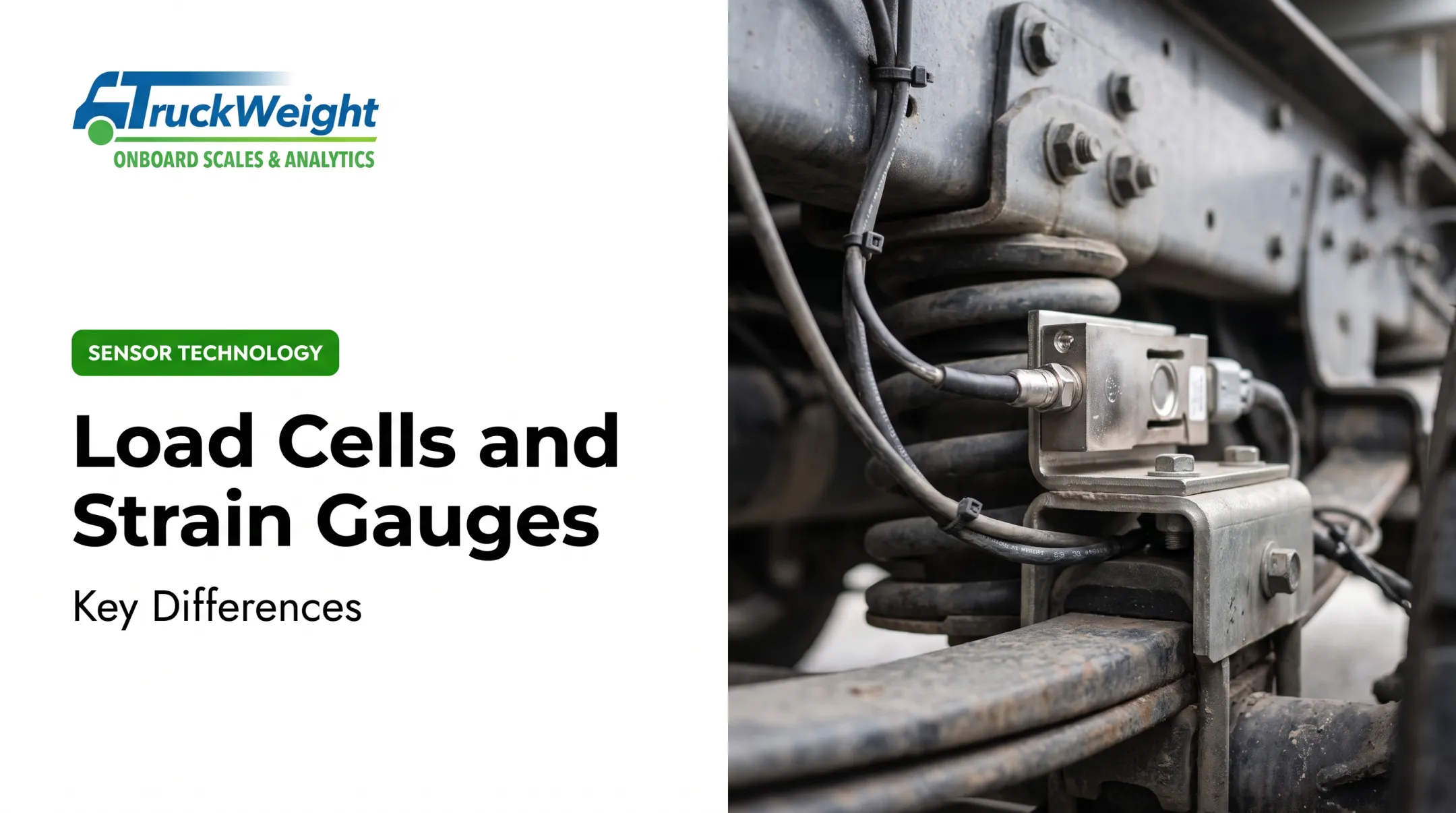
A load cell is a transducer that converts physical force or weight into an electrical signal. It does this through strain gauge deformation — as force is applied, the load cell's structure deforms slightly, changing the electrical resistance of bonded strain gauges wired into a Wheatstone bridge circuit. That resistance change becomes a readable weight signal.

In commercial trucking, that signal is how fleets stay legal. Federal limits cap single axles at 20,000 lbs, tandems at 34,000 lbs, and gross vehicle weight at 80,000 lbs, though state limits and permits can adjust these figures.
Core benefits of load cells:
- High measurement accuracy for force and weight
- Direct force reading (no conversion or inference needed)
- Versatility across capacities, from lab-scale to heavy-duty truck axles
Load Cell Variations
Load cells come in a few common configurations:
- Compression load cells — measure force pushing down on the sensor
- Tension load cells — measure pulling force
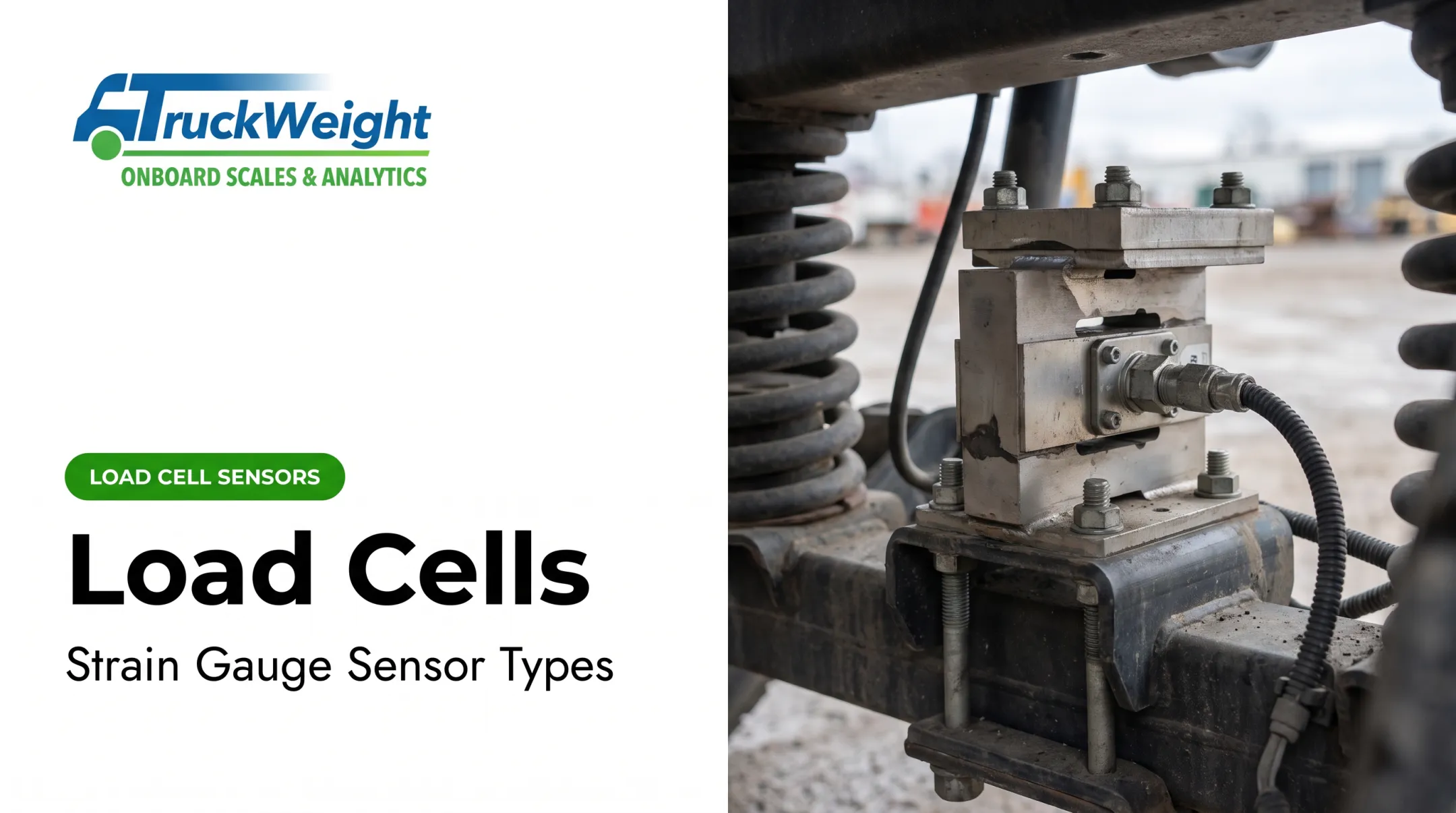
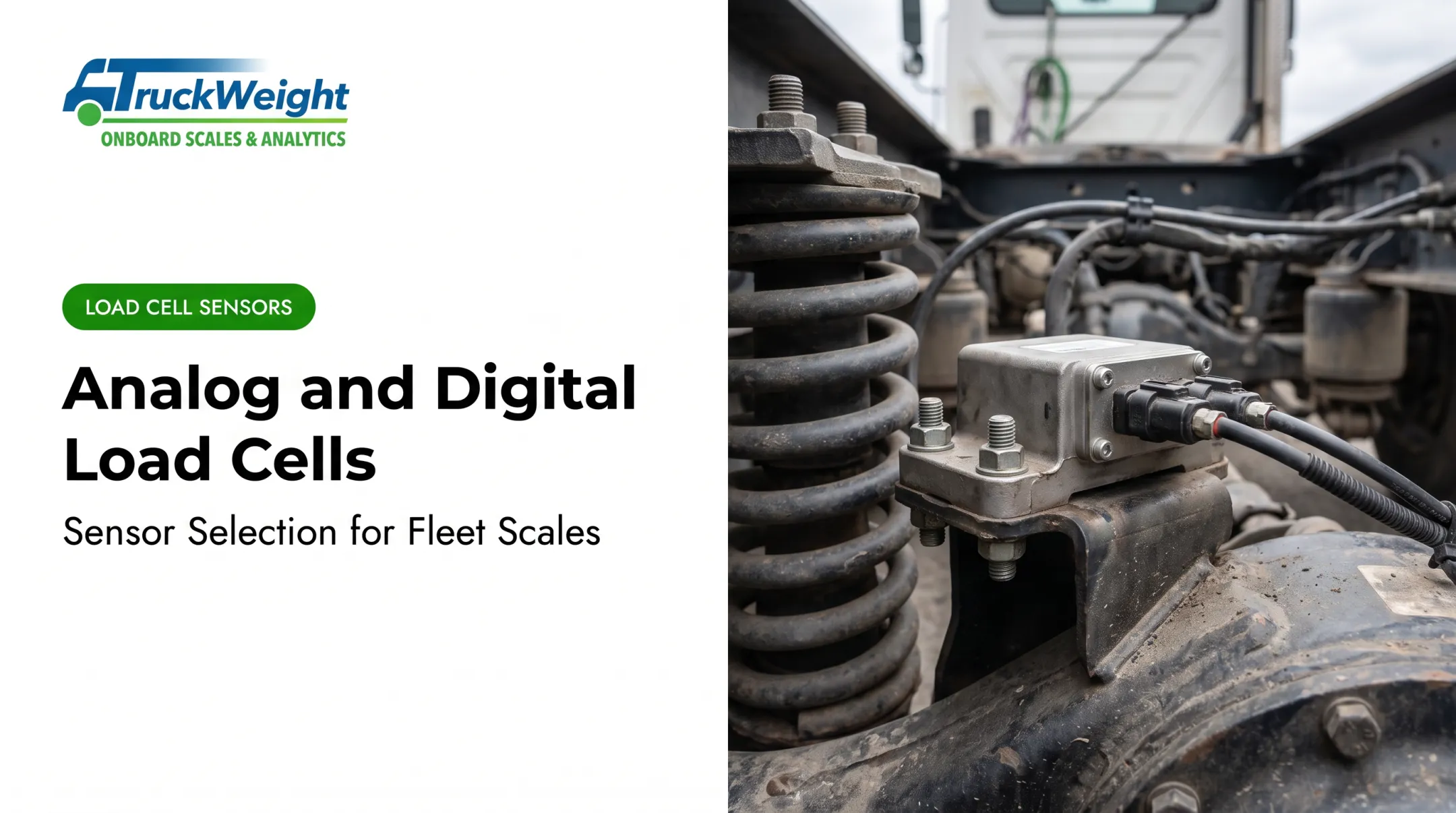
- Strain gauge-based onboard sensors — used in truck suspension systems for real-time axle weight monitoring
TruckWeight's SG-1 and SG-2 strain gauge sensors are practical examples for onboard use:
- SG-1 — front-axle applications
- SG-2 — spring trailers, drive axles, walking-beam suspensions, and Chalmers systems
- Rated accuracy — 0.3%–2% of gross vehicle weight once calibrated
- Build — waterproof, shock-resistant, and corrosion-resistant
TruckWeight also offers a patented air suspension sensor. It reads pressure and temperature changes rather than strain deformation, and hits 0.3%–1% accuracy in all weather conditions.
Use Cases of Load Cells
Load cells are the go-to sensor when fleets need precise weight data for payload and compliance decisions. Common trucking use cases include:
- Onboard truck scales for real-time axle-group and GVW readings
- Loading-point checks so drivers correct weight before leaving the site
- Dump, refuse, logging, and aggregate trucks on spring or mixed suspensions
- Tractor-trailer setups that need axle and net payload visibility from the cab
Aggregate hauling, construction, mining, and logging fleets rely on load cells most. These operations run tight margins, and a single overweight ticket can wipe out the profit on a run.
Take Tri County Block & Brick, a TruckWeight customer that loads sand and stone at a quarry. Before installing a load-cell-based Smart Scale, the company was losing trips because yard weight checks weren't accurate enough. At roughly seven loads a day, bad readings meant under-loading (wasted capacity) or risking overweight fines. The onboard scale let crews hit target weight at the pile instead of guessing or detouring to a platform scale.
That same loading risk shows up at roadside inspections across the U.S. Overweight citations still catch operators who only discover a problem after they are already on the highway. Real-time onboard weighing gives drivers a chance to fix axle or gross weight during loading—before it becomes a citation.
What is a Hall Sensor?
A Hall sensor is a magnetic field detector. It generates a voltage output proportional to the strength of a nearby magnetic field, based on the Hall effect: a phenomenon where a magnetic field applied perpendicular to a current-carrying conductor produces a measurable voltage.
For vehicles and industrial equipment, this translates into position and motion sensing, not force measurement.
Core benefits of Hall sensors:
- Contactless operation, no mechanical wear
- Long service life
- Fast response time
- Resistance to dust, vibration, and moisture
Hall Sensor Variations
- Linear Hall sensors: output an analog signal proportional to magnetic flux density, useful for measuring position along a range
- Switch-type Hall sensors: output a digital signal when field strength crosses a threshold, useful for on/off detection
Where Hall Sensors Fit in Commercial Vehicles
Common applications include:
- Throttle position sensing
- Wheel speed sensing
- Suspension height detection
- Door and latch proximity switches
These sensors dominate in automotive position sensing, industrial automation, and RPM monitoring. Because they're contactless, Hall ICs avoid the contact bounce and wear that plague mechanical switches.

Allegro MicroSystems notes that Hall switches transition without contact bounce and use hysteresis to suppress spurious oscillation. That durability advantage matters in vibration-heavy trucking environments.
That said, Hall sensors aren't immune to problems. Automotive-grade Hall ICs need to withstand electrical noise, temperature swings, and magnetic interference. Serious automotive applications require AEC-Q100 qualification and ISO 26262 safety documentation, not just any commodity Hall chip.
Load Cell vs Hall Sensor: Which is Better?
Neither sensor is universally "better." The right choice depends on:
- What you're measuring: force/weight versus position/speed
- Budget: load cells typically cost more per unit
- Environmental exposure: vibration, moisture, temperature extremes
- Required accuracy: weight compliance has legal stakes; position sensing usually doesn't
Choose a load cell when:
- Accurate weight data is required for axle and GVW compliance
- Onboard truck scale data is needed for payload optimization
Choose a Hall sensor when:
- You need contactless position or speed detection
- Harsh, vibration-heavy conditions matter more than force or weight data
Real-World Example: Weighing Technology in Commercial Fleets
Ritcey & Sons faced a familiar problem: rigid enforcement of weight laws was cutting into profits. Without accurate onboard weight data, the company couldn't confidently load close to legal limits without risking a citation.
Two fleets show what changes once guesswork is gone:
- Ritcey & Sons: After adopting TruckWeight's Smart Scale system, owner Matthew Ritcey could "run legal"—loading with confidence instead of guessing.
- Limar Enterprises: Before a wireless Smart Scale with handheld display, the best an operator could offer was "I think you're okay."
That uncertainty either leaves payload on the table or risks going over. With real-time readouts, the operator can confirm room for "another ton" and add it without guessing.
The bigger pattern: Industry reporting found that one fleet moving to closer-to-capacity loading needed 20-30% fewer vehicles to haul the same volume after replacing chronic underloading with accurate onboard weighing.

Precise force-based sensing is what makes that confidence possible when compliance and payload both hit the bottom line. If your fleet still estimates loads by eye, TruckWeight's wireless onboard scale systems deliver axle and gross vehicle weight data from the cab—on air or mechanical/spring suspension trucks.
Conclusion
The choice between load cells and Hall sensors comes down to one question: does your application need to measure force/weight, or detect position/proximity? Both technologies belong in modern commercial vehicle systems—they solve different problems.
For fleet operators, that split shows up in day-to-day results:
- Load cells support weight compliance and payload optimization, where fines and lost capacity hit profitability directly
- Hall sensors cover durable, low-maintenance position sensing elsewhere on the vehicle, including throttle position, wheel speed, and suspension height
Neither replaces the other. Match the sensor to the measurement job and you avoid buying complexity you do not need.
Frequently Asked Questions
What is the purpose of a load cell sensor?
A load cell sensor measures force or weight by detecting strain-induced deformation and converting it into an electrical signal. It's used in applications like onboard truck scales and industrial weighing where direct force data matters.
Do load cell pedals feel more realistic than Hall sensors?
In force-feedback applications, load cells register the pressure applied rather than position, making them feel more realistic for weight-based tasks. Hall sensors are better suited to position-based inputs, not force feedback.
Can a Hall sensor be used to measure weight?
No. Hall sensors detect magnetic fields for position or speed, not force, so they can't accurately measure weight on their own. A load cell is required for direct weight measurement.
Which sensor is more durable in harsh trucking environments?
Hall sensors are generally more durable thanks to their contactless design, which avoids mechanical wear. Load cells require careful installation and mounting to avoid damage from shock or vibration.
Are load cells more expensive than Hall sensors?
Yes, typically. Load cells cost more due to precision engineering required for accurate force measurement. Hall sensors are lower-cost but limited to position and proximity sensing.
How do onboard truck scales use load cell technology?
Onboard scales use strain gauge or load-cell-based sensors mounted on axles or suspension components. These provide real-time weight readings viewable from the cab through a handheld or long-range display.