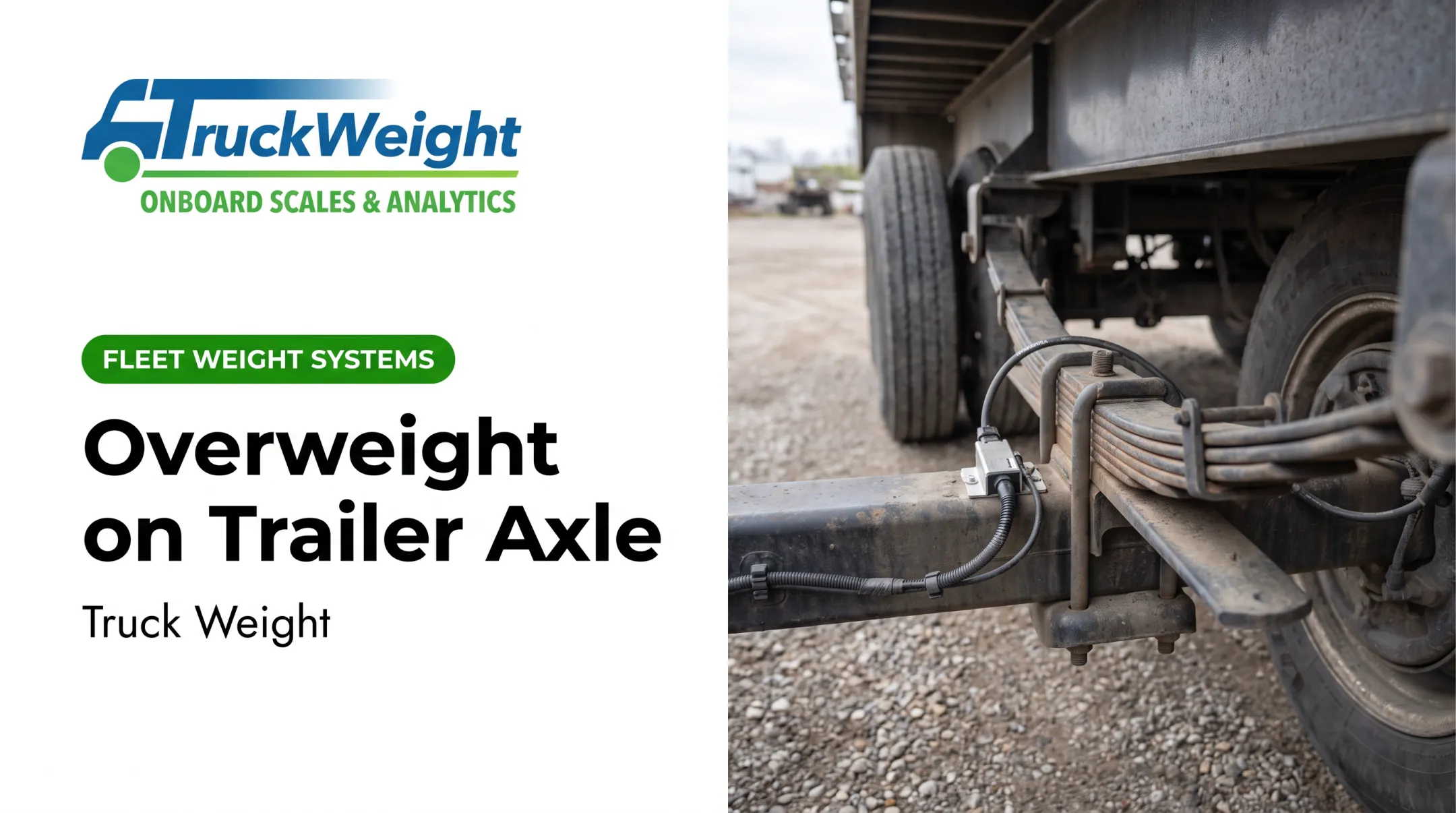

This happens more often than most drivers admit. Uneven shipper loading, a drop-and-hook trailer nobody rebalanced, cargo that shifted three states back. Sliding your tandems can fix it, but only if you know the hole spacing, the direction to move, and how to verify the result before you pull back onto the highway.
Here's the exact process, the variables that trip people up, and how to check your work without burning an hour at a public scale.
Key Takeaways
- Slide tandems rearward to shift weight off trailer axles onto the drives; forward reverses it
- Federal Interstate limits: 34,000 lbs per tandem, 80,000 lbs gross combined
- Distribution only—if GVW is already over 80,000 lbs, sliding will not fix it
- Always re-weigh after sliding. Never trust an estimated per-hole shift
- Onboard scales like TruckWeight's wireless systems show axle-group weights from the cab after a slide
How to Take Weight Off a Trailer Axle
Step 1: Weigh the Truck and Identify the Overweight Axle
Before you touch the slider, find out exactly which axle group is over and by how much. A gross weight reading alone won't tell you that.
Get separate numbers for:
- Steer axle
- Drive axle group
- Trailer axle group
Use a certified public scale, a portable axle scale, or an onboard wireless system. TruckWeight's display, for example, shows individual axle-group readings simultaneously on one screen: Front Axle, Drives, Trailer, plus TOTAL and NET weight. That kind of breakdown tells you which group needs to shed weight before you even move the truck.
Step 2: Find a Safe, Level Area to Slide Tandems
Don't attempt this on a slope, in gravel, or anywhere near live traffic. Pull into a flat, clear area such as a truck stop, weigh station lot, or rest area with enough room to maneuver.
- Set the trailer brakes before releasing the slide mechanism
- Confirm no bystanders are near the trailer
- Never stand under or beside an unsupported trailer frame
This is a safety step, not a formality. A slider that lets go unexpectedly can shift hundreds of pounds of frame in a second.
Step 3: Release the Locking Pins and Slide the Tandem
Pull the release handle (or trigger the air-operated release on newer trailers), then move the tractor slowly:
- Reverse the tractor to move the tandems forward
- Drive forward to move the tandems backward
Remember the direction logic:
- Sliding tandems forward shifts weight toward the drive axles and takes weight off the trailer group
- Sliding tandems backward takes weight off the drives and loads the trailer axles

Move in small increments—one or two holes at a time—unless you already know exactly how much you need to shift.
Step 4: Re-Engage Pins and Re-Weigh
Stop at your target hole and re-lock the pins on both rails, not just one side.
- Push the release handle back into the locked position
- Do a controlled tug test: gently rock the tractor forward and back to confirm the pins are seated
- Visually check both sides of the slider rail
- Re-weigh on a scale or onboard system before continuing your trip
Don't estimate. Don't assume one hole equals a fixed number of pounds and drive off. Confirm it.
When Should You Slide Trailer Tandems to Take Weight Off the Axle?
This method works when your gross weight is legal but one axle group is over, typically the trailer or drive tandem. Common triggers:
- Shipper loaded the trailer unevenly
- You picked up a drop-and-hook trailer that nobody rebalanced
- Cargo shifted during a long haul or rough road stretch
When it fails: If gross vehicle weight already exceeds 80,000 lbs on an Interstate, sliding tandems changes nothing. You are only moving weight between axle groups, not cutting the total.
At that point you need a reduced load or an overweight permit, not another slide.
What You Need Before Adjusting Trailer Tandems
Getting this right the first time saves repeated trips back to the scale.
Before you slide the tandems, confirm you have:
- A way to read axle-group weights: certified scale, portable axle scale, or onboard wireless system
- A slider mechanism in good working order, with pins that release and lock cleanly
- Rails free of rust or debris that could jam travel
- A level surface and wheel chocks so the trailer stays put while you adjust
Check compliance before you move anything:
- Federal Interstate limits: 34,000 lbs per tandem group, 80,000 lbs gross, subject to the bridge formula 23 CFR 658.17
- State-specific rules, including stricter kingpin-to-rear-axle or spacing limits in some states
- Route restrictions near permit-only corridors
Key Parameters That Affect Results
The amount of weight shifted per hole isn't a fixed number. It depends on several things working together.
Hole Spacing on the Slider Rail
Trailers commonly use 4-inch or 6-inch hole spacing. Wider spacing generally shifts more weight per hole than tighter spacing, but there's no universal industry conversion.
Schneider's carrier training cites roughly 250 lbs per hole as a general example, not a fixed rule. Guessing the spacing on your specific trailer leads to under- or over-correcting.
Distance Moved and Trailer Length
Total slide distance combined with your trailer's wheelbase determines how much weight transfers between drive and trailer axles. Slide too far in either direction and you'll also affect:
- Turning radius on docks and city streets
- Rear swing on tight corners
- Tire scrub and uneven wear over long hauls
Cargo Position Inside the Trailer
A tandem slide can't fix concentrated or unevenly loaded freight. Your scale ticket might read legal, but a load stacked toward the nose or tail can still create handling problems and rollover risk on curves or in wind.
Bridge Formula and State Rules
Axle spacing can push your allowable weight below the standard 34,000 lb tandem limit. The FHWA's bridge formula applies to any group of two or more consecutive axles. A slide that satisfies federal single-group limits can still violate a bridge formula check or a state-specific rule like California's 40-foot kingpin-to-rear-axle cap.
Common Mistakes and Troubleshooting
Common Mistakes
- Trusting an estimated per-hole shift instead of re-weighing after the slide
- Checking only one side of the slider rail and missing a pin that didn't engage
- Sliding to an extreme position without checking the resulting bridge formula or kingpin limits
Troubleshooting
Axle weight barely changed after sliding. Check for cargo shift, a miscounted hole, or a load that was unevenly placed by the shipper to begin with.
Pins won't lock. Look for debris, ice, low air pressure, or frame tension preventing full engagement. Don't force it. Clear the obstruction first.
Gross weight is legal but multiple axle groups keep failing. That's not a tandem-slide problem. That's a cargo placement problem. You likely need to reposition freight or send the trailer back to the shipper for correction.
After each fix, you still need a fast way to confirm the new axle split before you roll. An onboard wireless scale, like TruckWeight's systems for trucks and trailers, shows axle-by-axle readings from the cab right after each slide—so you are not driving back to a public scale for every small adjustment.
TruckWeight's air suspension sensors are rated at 0.3% to 1% accuracy in varied weather, giving drivers a close read before a full scale stop.
Frequently Asked Questions
How much weight does each hole shift when sliding trailer tandems?
Estimates vary, roughly 250 lbs per hole on some trailers, but this depends heavily on hole spacing and load distribution. Always confirm with a certified scale or an onboard scale rather than relying on a fixed number.
Does sliding the trailer tandems reduce gross vehicle weight?
No. Gross weight stays exactly the same. Sliding only changes how that weight is distributed between the drive and trailer axle groups.
What is the legal weight limit for a trailer tandem axle group?
The federal Interstate limit is 34,000 lbs per tandem group under 23 CFR 658.17. Some states apply stricter spacing or bridge formula rules on top of this.
Can I slide tandems by myself safely?
Yes, if you follow basic precautions: level ground, trailer brakes set, pins fully released and then fully re-engaged, and the area clear of bystanders before you move the tractor.
What should I do if the trailer axle is still overweight after sliding tandems as far as possible?
Go back to the shipper for a load adjustment, or apply for an overweight permit through your state's DOT. Tandem travel has a physical limit, and once you hit it, redistribution alone won't help.
How can I check axle weights without stopping at a public scale every time?
Wireless onboard scale systems, like TruckWeight's, display gross, axle-group, and net weights from the cab. You get a real-time check after every slide—no detour to a certified scale.