
This is a growing problem for fleets that push payloads to maximize every run. Overloading strains braking systems, weakens mechanical components, damages roads, and opens carriers up to serious legal exposure.
Here's the good news: most of this risk is preventable. Onboard weighing technology like TruckWeight lets operators catch an overload before the truck ever leaves the yard, not after a scale inspector or a crash investigator finds it.
Key Takeaways
- Overloaded dump trucks need more stopping distance and face higher rollover risk on curves and ramps
- Overweight violations trigger fines, CSA score damage, and increased civil liability after accidents
- Onboard scales verify axle-group and gross weight before dispatch, catching problems at the loading site
What Makes Dump Trucks Uniquely Dangerous When Overloaded
Dump trucks fall into a vehicle category called single-unit trucks (SUTs), meaning the cab and cargo body are one rigid unit rather than a separate tractor and trailer. This design, combined with a high center of gravity and shifting payloads, creates a distinct risk profile.
Federal crash data backs this up. SUTs were involved in about 3% of fatal crashes and 1.7% of injury crashes in one NHTSA analysis, resulting in 1,064 deaths and roughly 38,000 injuries in a single year.
Rollover was a factor in 16% of the fatal-crash SUT sample and 8% of the injury-crash sample.

Why does overloading make this worse?
- A raised or heavy dump body shifts weight higher, lowering the rollover threshold
- FMCSA benchmarks put rollover risk above 0.35 g of lateral acceleration for high-CG vehicles; ordinary curves and ramps generate only 0.05–0.17 g
- Unlike a passenger car, a dump truck's payload can vary load to load, meaning drivers may not know they're overloaded until it's too late
Passenger vehicles carry a fixed, known weight. Dump trucks don't. That load-to-load variability is the real risk.
The Core Dangers of Overloaded Dump Trucks
Braking and Stopping Distance Failures
Extra weight means extra momentum, and momentum has to go somewhere when the brakes engage. Overloaded trucks strain braking systems, which can overheat and lose effectiveness over a run.
An FHWA stability simulation modeled a heavier configuration needing 255 feet to stop, versus 235 feet for a standard 80,000-lb control vehicle on the same brakes. That 20-foot gap is a real loss of stopping margin in an emergency.
There is no universal "add X feet" formula. Stopping distance still depends on brake condition, tire grip, speed, and grade—but the pattern holds: more weight, less stopping margin.
Mechanical and Structural Failures
Overloading doesn't just strain brakes. It accelerates wear across the entire truck:
- Suspension and axles absorb forces beyond their rated capacity
- Tires carrying excess load can exceed their bearing rating and fail
- Hydraulic lift systems take added stress when raising an overloaded bed
Raised-bed incidents are especially severe. OSHA reviewed 31 elevated dump-body accidents over a decade; nearly all were fatal, and most involved missing or misused body props during maintenance under a raised bed.
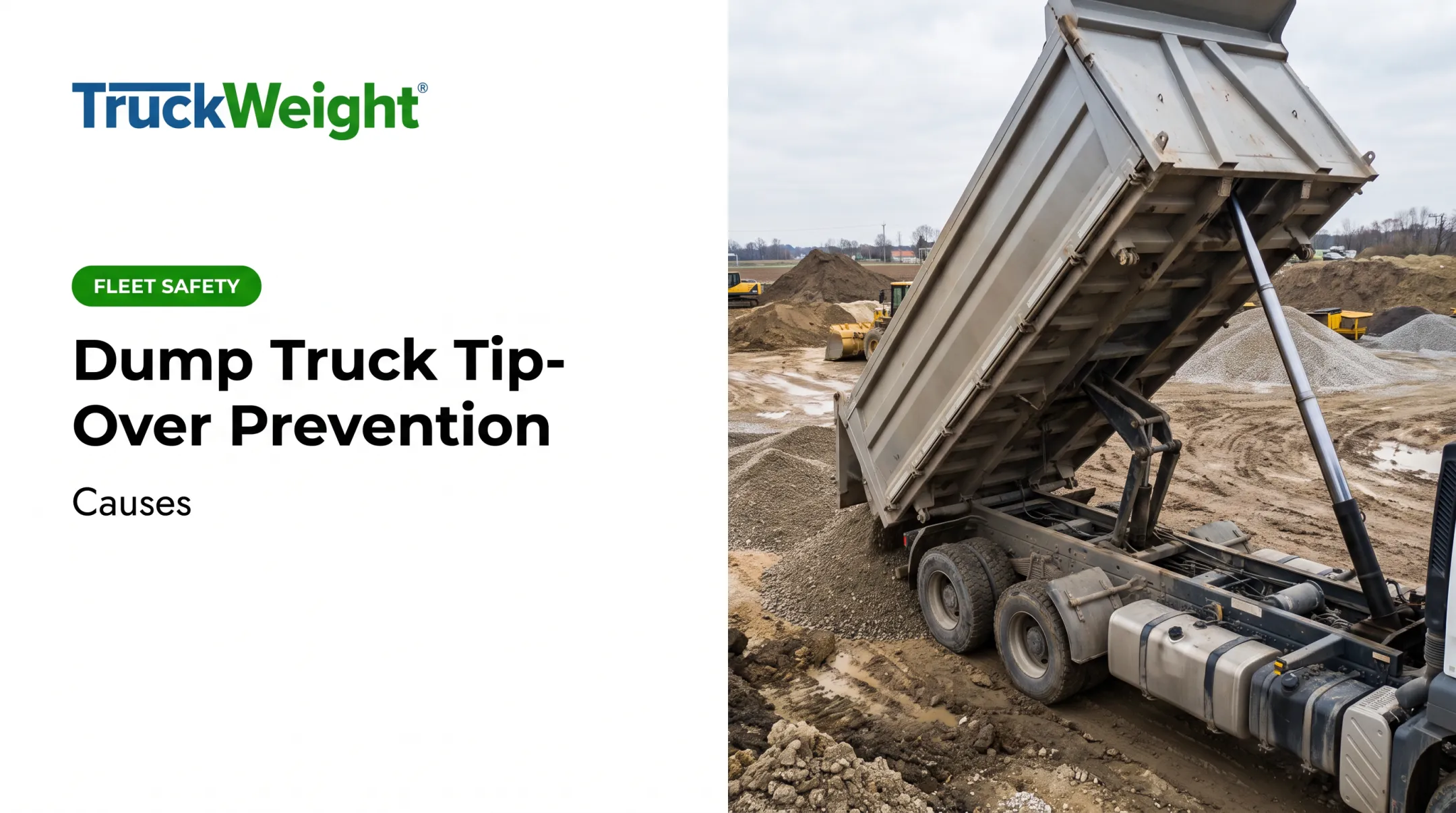
The same raised-bed stress shows up during the dump cycle. Tipping risk climbs sharply when an overloaded bed is raised on an incline or soft ground. In one OSHA case, a dump truck backed onto a bank; the bank failed, the truck rotated over its rear wheels with the bed raised, and the cab partially collapsed.

Loss of Vehicle Control
A heavier, higher-riding load changes how a truck handles curves and ramps. A peer-reviewed analysis of federal crash causation data found 26 rollovers tied to loads that were too heavy, insecure, or mounted too high. Improperly loaded cargo figured most often on ramps and curves, not straightaways.
Speed compounds the problem. Roughly a quarter of the rollovers in that same sample stemmed from drivers failing to adjust speed for load height and weight. There's also the overcorrection trap: when a heavily loaded truck's tires drift off the pavement edge, a sharp steering correction can flip an already top-heavy vehicle.
Falling Debris and Road Hazards
Federal cargo rules (49 CFR 393.100) require loads to be secured against leaking, spilling, or blowing off the vehicle. Overloaded or poorly contained beds increase the chance of material escaping onto the roadway, creating a hazard for the vehicles behind.
Gravel, sand, and similar bulk materials fall outside standard securement rules because of their loose form, so loading practice and containment matter even more for dump operators.
Road and Infrastructure Damage
Overloading doesn't just endanger the truck and other drivers. It damages the roads themselves.
FHWA's pavement research uses an 18,000-lb axle as its baseline unit of wear. In one AASHO Road Test example, 100 passes by a 20,000-lb axle caused pavement damage equivalent to 150 passes by an 18,000-lb axle. Weight adds up fast, and it doesn't scale evenly.
FHWA also calculated that a 72,000-lb, four-axle dump truck produced 21% greater stress on short bridge spans than the standard highway design vehicle, despite matching the gross weight of a longer tractor-semitrailer. Axle spacing and concentration matter as much as total tonnage.

Legal, Financial, and Regulatory Consequences
Weight limits aren't arbitrary. Federal interstate rules (23 CFR 658.17) set hard caps:
- Gross vehicle weight: 80,000 lbs
- Single axles: 20,000 lbs
- Tandem axles: 34,000 lbs
Bridge-formula rules can push those limits lower on specific routes.
States enforce their own fine schedules on top of this. Texas, for example, charges:
| Overweight amount | Fine range |
|---|---|
| Under 2,500 lbs | $100-$500 |
| 2,500-5,000 lbs | $500-$1,000 |
| 5,001-10,000 lbs | $1,000-$2,500 |
| 10,001-20,000 lbs | $2,500-$5,000 |
| Over 40,000 lbs | $7,000-$10,000 |
Beyond fines, FMCSA's Compliance, Safety, and Accountability (CSA) program tracks roadside violations and crashes over a rolling 24-month window. Carriers are scored against seven safety categories. Overweight violations feed directly into that record and follow the carrier, not just the individual truck.
The exposure does not end with the citation. In accident litigation, scale records and inspection logs get pulled during discovery. A documented overweight condition at the time of a crash can raise civil liability, regardless of who caused the accident.
How to Prevent Overloading and Protect Your Fleet
Prevention starts with routine habits, then gets reinforced with technology.
Basic practices every fleet should follow:
- Run pre-trip weight checks before leaving the loading site
- Spot loads visually for uneven distribution
- Inspect for loose or excess material sitting on the tailgate or bed lip after loading
These habits catch obvious problems. But visual checks miss the details that actually cause violations, like an axle group that's over limit even though gross weight looks fine.
Onboard Scales Close That Gap
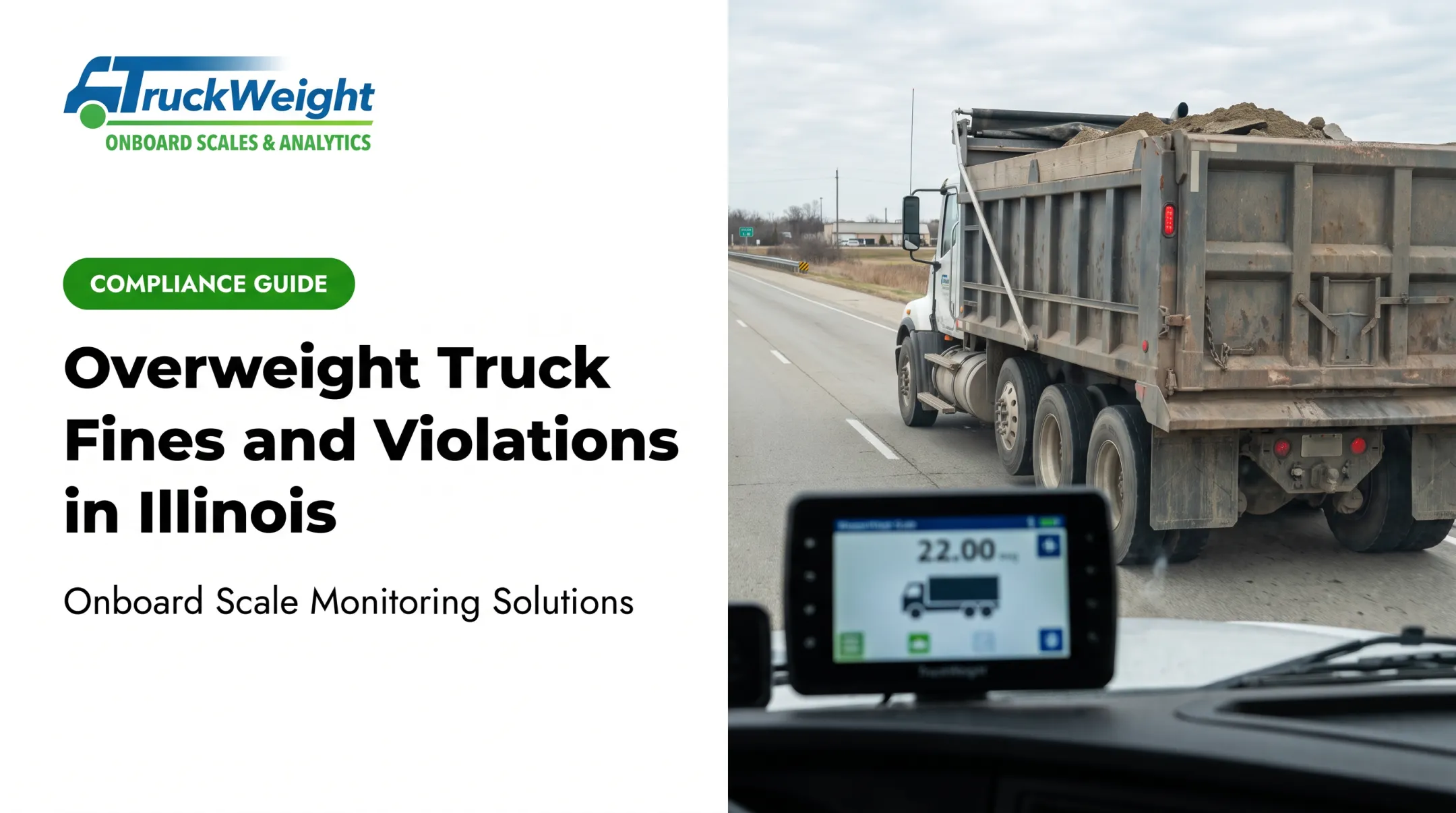
TruckWeight's in-cab display shows axle-group, gross vehicle, and net weight in real time, covering front axle, drive axles, and trailer readings separately. That means an operator can spot an overloaded axle group before it becomes a roadside citation, not after.
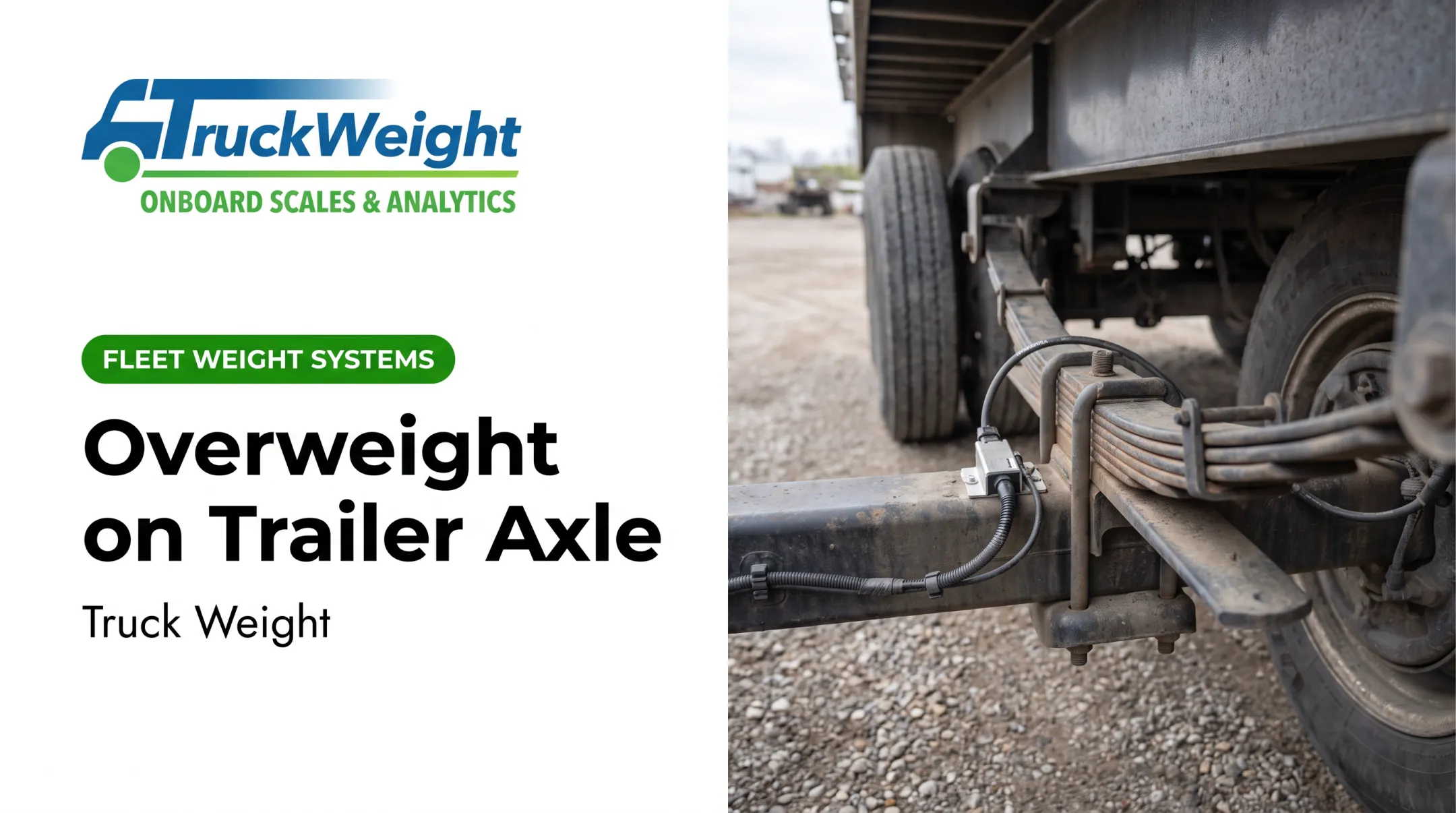
The system runs wirelessly, using strain-gauge sensors (SG-1/SG-2) for mechanical suspensions or a patented air sensor for air-ride setups. Documented accuracy is 0.3%-2% of gross vehicle weight, and drivers can check readings from the cab or from within 100 feet of the trailer.
At Ritcey & Sons, owner Matthew Ritcey put it plainly: strict weight-law enforcement was cutting into profits, and TruckWeight's Smart Scale helped the company "run legal."
At Limar Enterprises, the loader operator uses the handheld display to confirm there's "room for another ton" instead of guessing.
Fleet-Wide Compliance Without the Weigh-Station Detour
For fleets running multiple trucks, TruckWeight Analytics (TWA) adds a compliance layer on top of individual scales:
- Remote calibration and sensor configuration from any location
- Overweight alerts sent to back-office teams
- Centralized weight data reporting across sites and vehicles
- Cloud integration through Google Firestore, BigQuery, and PubSub for telematics platforms

The goal is fewer detours to public scales, fewer surprise fines, and a documented weight record if a load is ever questioned.
Frequently Asked Questions
How can you tell if a dump truck is overloaded?
Look for visual sag in the suspension, unusually long stopping distances, and uneven tire wear. The only reliable method is checking weight against a certified onboard or ground scale before you leave the site.
How much can a dump truck hold?
This depends entirely on the truck's class, GVWR, and the material being hauled. Check manufacturer specifications rather than estimating capacity by eye.
What is the legal weight limit for a dump truck?
Federal interstate limits cap gross weight at 80,000 lbs, with 20,000 lbs on a single axle and 34,000 lbs on tandems. State and local roads often set different, sometimes lower, limits, so check your specific route.
Can an overloaded dump truck tip over?
Yes. Tipping risk rises sharply when an overloaded bed is raised on an incline, soft ground, or uneven terrain during dumping.
What happens if a dump truck is caught overweight?
Drivers and carriers face state fines that scale with the amount over the limit, sometimes into thousands of dollars for larger violations. Overweight loads may also need to be reduced on the spot, and violations feed into the carrier's FMCSA CSA safety record.
How can onboard scales help prevent overloading?
Onboard scales show axle-group and gross weight in real time, right at the loading site. That gives operators the chance to adjust a load before dispatch instead of discovering the problem at a weigh station or after a crash.