
Overweight fines, axle violations, and wasted payload capacity often trace back to one misunderstanding: drivers assume a load cell reading is a hard fact, when it's actually an estimate with a built-in margin of error. That margin matters. On a 34,000 lb tandem axle limit, even a small percentage of inaccuracy can push you over the line without you knowing it.
This guide breaks down what load cells measure, the specs that define their accuracy, and how fleets can verify readings hold up under real hauling conditions, not just in a lab.
Key Takeaways
- Load cells measure force—not weight directly—by converting mechanical strain into an electrical signal
- Accuracy hinges on non-linearity, hysteresis, repeatability, creep, and temperature effects, usually rated as % of full-scale output (%FSO)
- Onboard truck scale accuracy differs from lab-tested load cell specs due to installation, suspension type, and vibration
- Regular calibration and matched sensor technology improve payload efficiency and reduce overweight compliance risk
What Does a Load Cell Actually Measure?
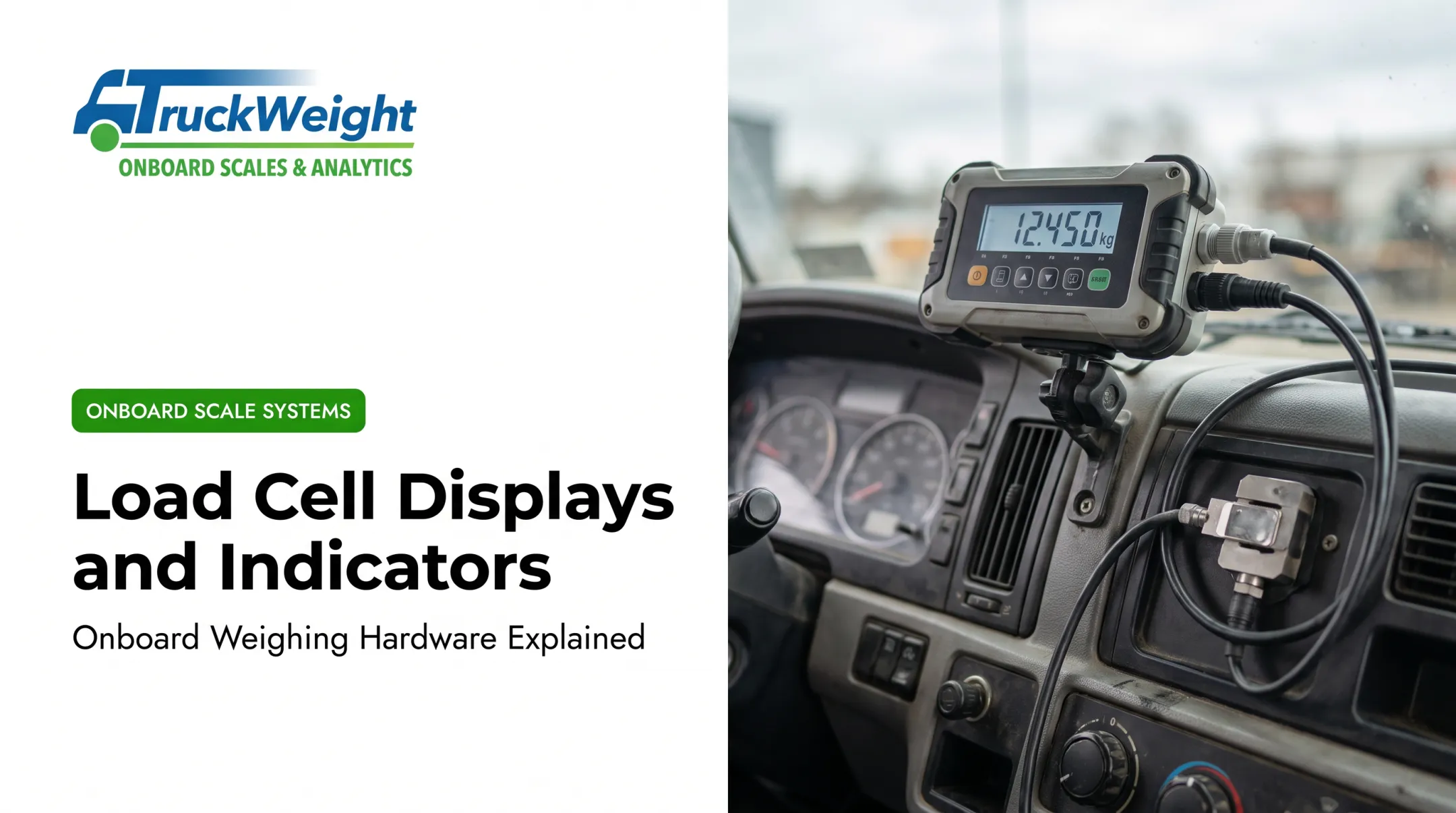
A load cell is a transducer. It converts mechanical force, whether compression, tension, or shear, into an electrical signal using strain gauges bonded to a metal body. When force bends that metal body, the gauges stretch or compress, changing their electrical resistance.
Here's the distinction that trips people up: load cells measure force, not weight. Weight is force under gravity, so you calibrate the sensor's output to represent weight once you account for gravitational pull. That calibration step is where accuracy specs come into play.
The signal path looks like this:
- Excitation voltage flows into the strain gauge
- Applied force produces a tiny millivolt output proportional to the strain
- An amplifier converts that signal into the weight reading on your display

According to FUTEK's load cell accuracy guidance, industry specs for strain gauge load cells typically range from about 0.03% of full scale on high-precision units to around 0.5% on general-purpose sensors. That's the sensor alone, under lab conditions.
Once you mount that sensor on a truck axle in the field, real-world accuracy shifts. Those field factors matter as much as the lab rating.
Core Specifications That Define Load Cell Accuracy
Datasheets throw around several accuracy terms, and they don't all mean the same thing. Here's what each one actually tells you.
Non-Linearity and Hysteresis
Non-linearity measures how far the actual output curve deviates from a theoretical straight line across the load range. A perfectly linear sensor would produce output that scales exactly with load; real sensors deviate slightly from that line.
Hysteresis is different. It's the gap between output readings for the same load, depending on whether you reached that load by adding weight or removing it. Load a cell to 10,000 lbs from empty, then unload it back down to 10,000 lbs from a heavier load, and you might see two slightly different readings.
Most datasheets combine these two into a single combined error spec, often the headline accuracy number you'll see advertised.
Repeatability, Creep, and Temperature Effects
- Repeatability — how consistent readings are for the same load, applied repeatedly. Critical for check-weighing applications where you're comparing loads over time.
- Creep — gradual output drift when a load sits on the cell without moving, typically expressed as %FSO over 30 minutes.
- Temperature effect on zero and span — how ambient temperature shifts the baseline reading and the sensor's sensitivity.

For trucking specifically, temperature effect matters more than most people realize. A sensor sitting on an axle sees temperature swings from a cold morning start to hot pavement by afternoon. That's why a compensated temperature range isn't optional—it's the band where the manufacturer has already corrected for thermal drift.
Factors That Reduce Real-World Accuracy in Trucking
Lab specs describe a sensor sitting still on a test bench. A truck axle is nothing like a test bench.
Installation and Mounting
Improper mounting introduces error before the truck even moves. Readings skew from:
- Side loading
- Uneven suspension geometry
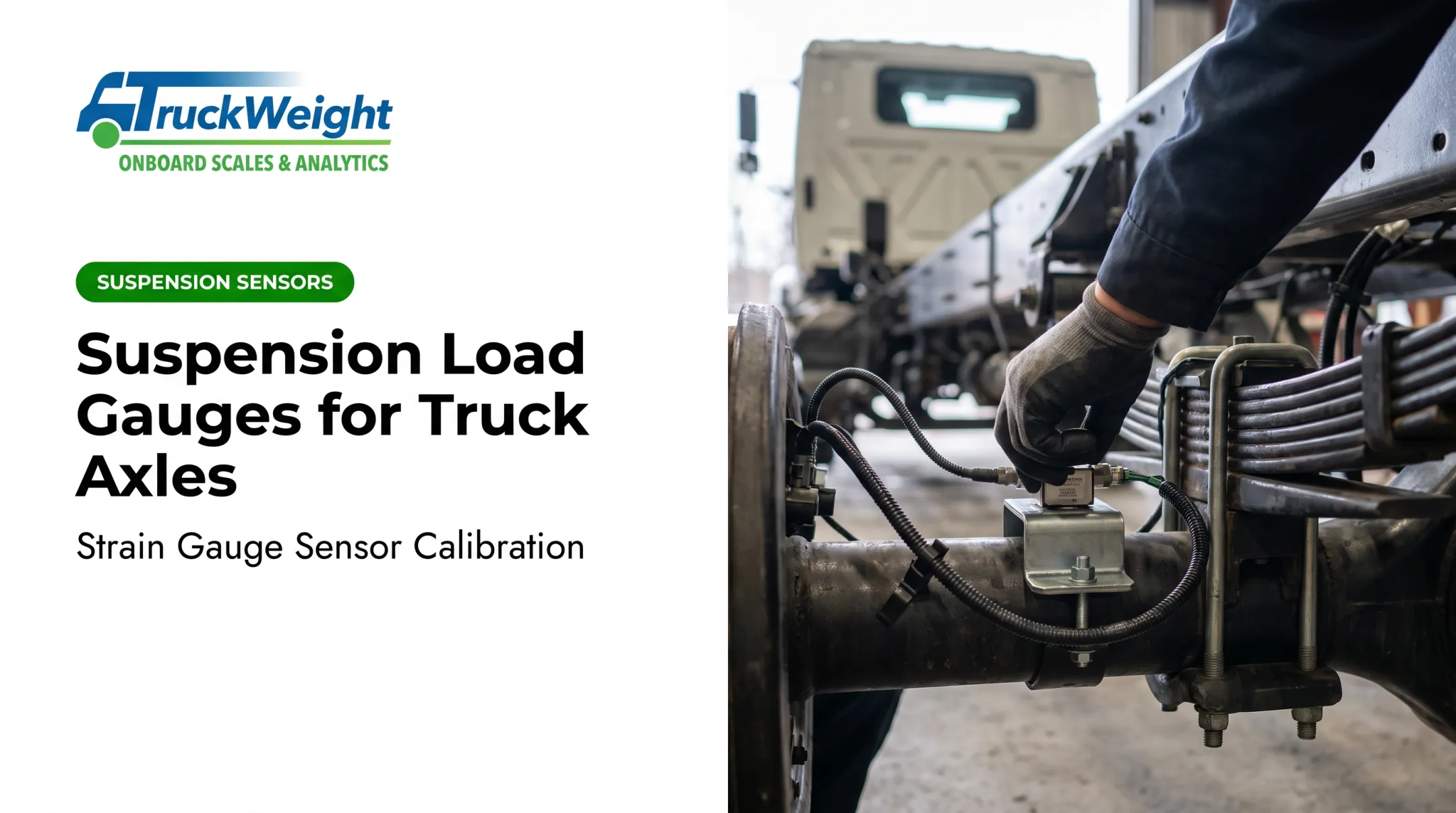
- Sensors bonded off-center on an axle Strain gauge sensors need to sit in a specific spot relative to the axle's center weld seam, not on top of it, to avoid distorted strain patterns.
Environmental and Operational Conditions
Vibration, road shock, moisture, and temperature swings all degrade sensor performance over time. This hits hardest in:
- Mining and quarry operations (constant shock loading on rough terrain)
- Construction sites (dust, moisture, uneven grades)
- Logging routes (extreme vibration on unpaved roads) Rice Lake's technical guidance recommends adding 25% to calculated load cell capacity to account for overfilling, shock loads, and severe conditions like these. Their white paper on tough applications covers the sizing rationale in detail.
Suspension Type Changes the Sensor Math
Mechanical (spring) suspensions require strain gauge sensors bonded directly to the axle or leaf spring. Air-ride suspensions instead use air pressure sensors, since load correlates with air bag pressure rather than physical strain. These aren't interchangeable, and each has its own accuracy profile shaped by suspension geometry, leveling valve condition, and mounting precision.
Calibration Drift
A sensor rarely fails all at once. It drifts gradually, and if nobody's checking, that drift goes unnoticed until a scale house flags an overweight violation. Broken springs, malfunctioning leveling valves, and skipping recalibration after suspension work are common, quiet culprits.

How to Calculate and Verify Load Cell Accuracy
The basic accuracy formula is straightforward:
Accuracy = (Measured Value − True Value) / True Value × 100
You need a certified reference weight to make this meaningful. Here's the verification process in practice:
- Zero-balance check — confirm the sensor reads zero (or the correct baseline) with no load applied, using stable excitation voltage.
- Load with a known reference weight — typically on a certified platform scale.
- Record the sensor's reading and compare it to the certified weight.
- Calculate percentage deviation using the formula above.
- Repeat periodically — frequency depends on how much risk an inaccurate reading poses to your operation.
Worked example: Say your onboard scale is rated at 0.5% full-scale output (FSO) combined error on a 1,000 lb test load. That translates to a potential variance of up to 5 lbs on that test load. Scale that up to a 34,000 lb tandem axle limit, and a 0.5% error band means a potential swing of 170 lbs—enough to push you over legal weight if you're already loading close to the limit.

TruckWeight calibrates its onboard systems against real reference points, not assumptions. Fleets weigh empty and loaded on a certified ground scale, record the sensor's corresponding PSI or strain reading, and enter both values into the system.
A PSI reading that differs by more than 0.3 PSI from the prior calibration point often means the vehicle isn't level, which throws off the whole reference.
Choosing Accurate Onboard Scale Technology for Fleets
A lab-rated sensor spec doesn't tell you how that sensor performs after 40,000 miles of gravel roads and temperature swings. Fleets need accuracy figures that hold up outside the lab. TruckWeight's patented air suspension sensor uses temperature and pressure changes within the suspension to calculate axle and gross vehicle weight, with a stated accuracy of 0.3%–1% in all weather conditions. For mechanical and spring suspensions, TruckWeight's SG-1 and SG-2 strain gauge sensors deliver system-level accuracy within 0.3%–2% of gross vehicle weight once calibrated. Field durability factors that protect accuracy:
- Waterproof, shock-resistant construction — holds up on logging and mining routes
- Wireless installation — avoids wiring failures common on vibrating axles
- Remote calibration support — TruckWeight Analytics lets fleets recalibrate and monitor sensors from the cloud Smart Scale Technologies Inc., the manufacturer behind TruckWeight, runs ISO 9001:2015-certified manufacturing processes. That certification does not guarantee a specific accuracy percentage on its own. It does mean design and production follow an audited quality system, which supports consistency from unit to unit. At Limar Enterprises, loader operators use the handheld display to see when there's room for another load and add payload with confidence. Ritcey & Sons tied legally compliant loads directly to protecting their margins.
Frequently Asked Questions
How do I calculate the accuracy of a load cell?
Use the formula (Measured Value − True Value) / True Value × 100 against a certified reference weight. Most manufacturers also publish a %FSO combined error spec on the datasheet you can cross-check with your own measurements.
What is considered a "good" accuracy rating for a load cell?
Combined error under 0.5% FSO is typically acceptable for most applications. Precision-critical uses may need 0.03%–0.1%, but that level isn’t required for most trucking work.
Why does temperature affect load cell readings?
Temperature changes cause thermal expansion in the sensor body and alter the electrical resistance of strain gauges. A compensated temperature range tells you where the manufacturer has corrected for this drift.
How often should onboard truck scales be calibrated?
Verify after overload events, suspension work, or large temperature swings, and on a set routine between those events. High-compliance hauling with tight weight margins needs more frequent checks than lower-risk routes.
Can vibration and road shock permanently damage load cell accuracy?
Yes. Repeated shock loading causes mechanical fatigue in the sensor over time, which shows up as gradual calibration drift rather than sudden failure. Regular verification catches this before it causes a violation.
What's the difference between load cell accuracy and load cell capacity?
Capacity is the maximum load the sensor is rated to handle. Accuracy describes how precisely it measures loads within that rated range—two separate specifications on the datasheet.