
These sensors sit inside load cells, torque transducers, and vehicle weighing systems across manufacturing, transportation, and infrastructure. Yet many operators and engineers treat them as a black box — which leads to poor sensor selection and misread output. This guide breaks down what a strain gauge actually is, how it works step-by-step, and where it earns its keep in real operations.
Key Takeaways
- Converts mechanical deformation (strain) into a measurable change in electrical resistance
- Uses a strain-sensitive material bonded to a surface, wired into a Wheatstone bridge for precise signal conversion
- Core stages: bonding, resistance change under load, bridge-based conditioning, calibrated voltage output
- Found in load cells, structural monitoring, vehicle weighing, aerospace testing, and industrial control systems
- Selection depends on gauge factor, material type, and whether the load is static or dynamic
What Is a Strain Gauge?
A strain gauge is a resistive sensing element, made of metallic foil, wire, or semiconductor material, whose electrical resistance changes in direct proportion to the mechanical strain applied to it. Strain itself is simple: it's the change in length of a material divided by its original length.
Engineers need to quantify how much a structure or component deforms under load—without cutting it open or destroying it. A strain gauge bonded to the surface does that non-destructively, in real time.
A strain gauge does not measure force, weight, or torque directly. It only measures strain. Getting to force, pressure, or weight requires calibration inside a transducer—such as a load cell—that translates the strain reading into a usable engineering unit.
Invented in 1938 by Edward E. Simmons and Arthur C. Ruge, the bonded strain gauge has stuck around because it's accurate, inexpensive, and adaptable.
Fiber-optic alternatives exist, but they are not a universal upgrade. A Virginia Tech wind-tunnel study found foil gauges outperformed fiber sensors in an unsteady test environment, even though fiber showed better resolution in controlled conditions.
Common types include:
- Bonded metallic foil gauges: most widely used; low-cost and reliable
- Semiconductor (piezoresistive) gauges: higher sensitivity for dynamic applications
- Configuration variants: linear, rosette (multi-directional), and shear gauges
The working principle stays constant across all of them. What changes is sensitivity, setup complexity, and cost.
How Does a Strain Gauge Work?
A strain gauge operates through a defined sequence: bonding, deformation, resistance change, and signal conversion. Each stage matters. Skip a step or botch the installation, and your readings drift.
Initiation: Bonding & Setup
The gauge is manually bonded with adhesive directly to the surface of the test object, carefully aligned with the expected direction of strain. This stage is entirely manual, and it demands proper surface preparation.
Poor bonding is the single most common source of measurement error. Air bubbles, contamination, or misalignment during installation will throw off every reading that follows.
The gauge also doesn't generate its own signal. It requires an external signal conditioner to supply excitation voltage (a passive sensor, not an active one).
Core Operation: Resistance Change
As the bonded object deforms under load, the gauge's conductive element stretches or compresses along with it. That physical change alters its length and cross-sectional area, which in turn changes its electrical resistance.
This relationship is governed by the gauge factor equation:
ΔR/R = K × ε
Where ΔR is the resistance change, R is nominal resistance, K is the gauge factor, and ε is strain. Metallic foil gauges typically carry a gauge factor around 2, according to NI's sensor fundamentals guide.
Semiconductor gauges can reach intrinsic gauge factors as high as 200 for single-crystal silicon in published sensor research. That means a much stronger signal for the same strain, with tradeoffs in linearity and stability.
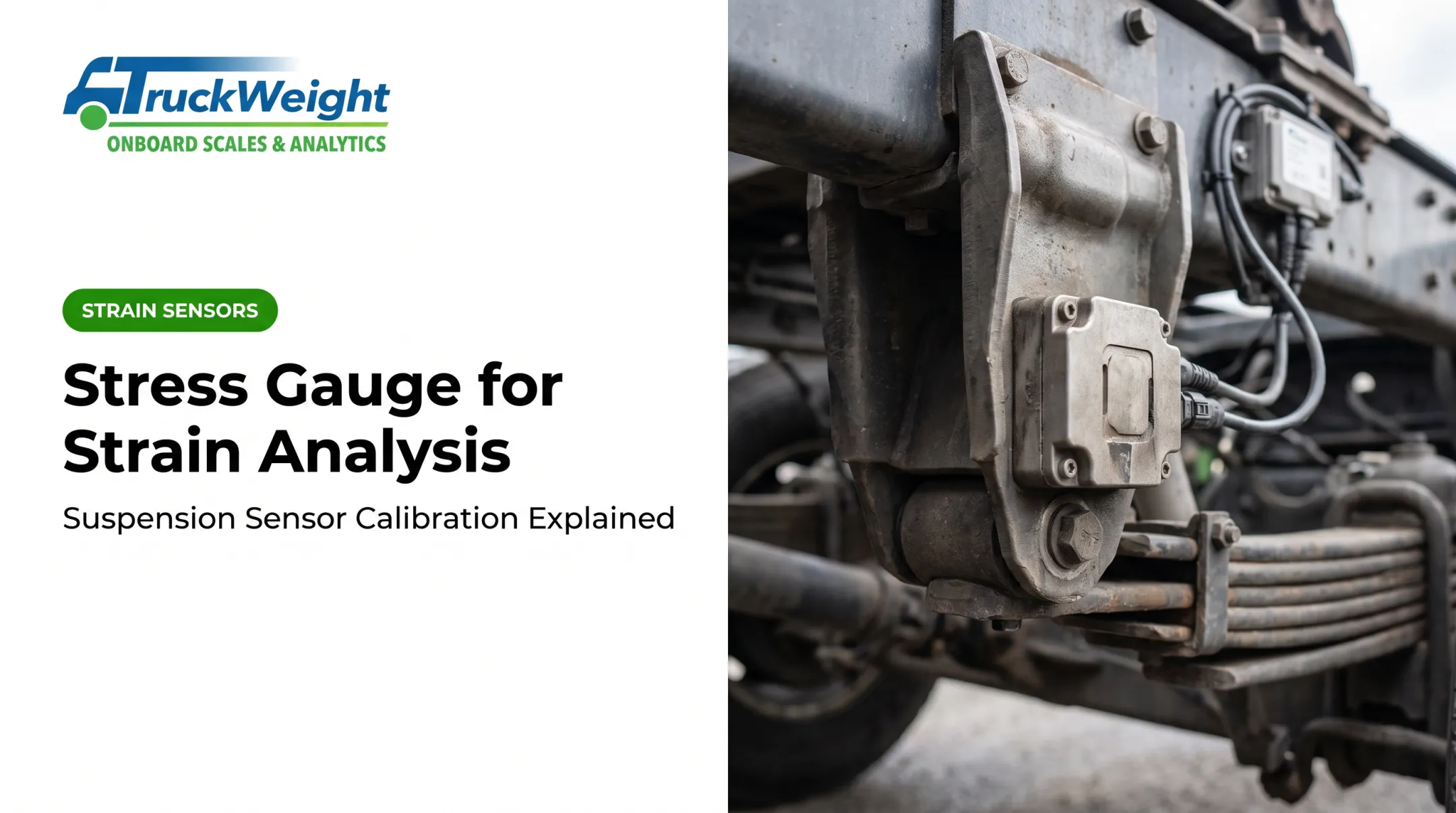
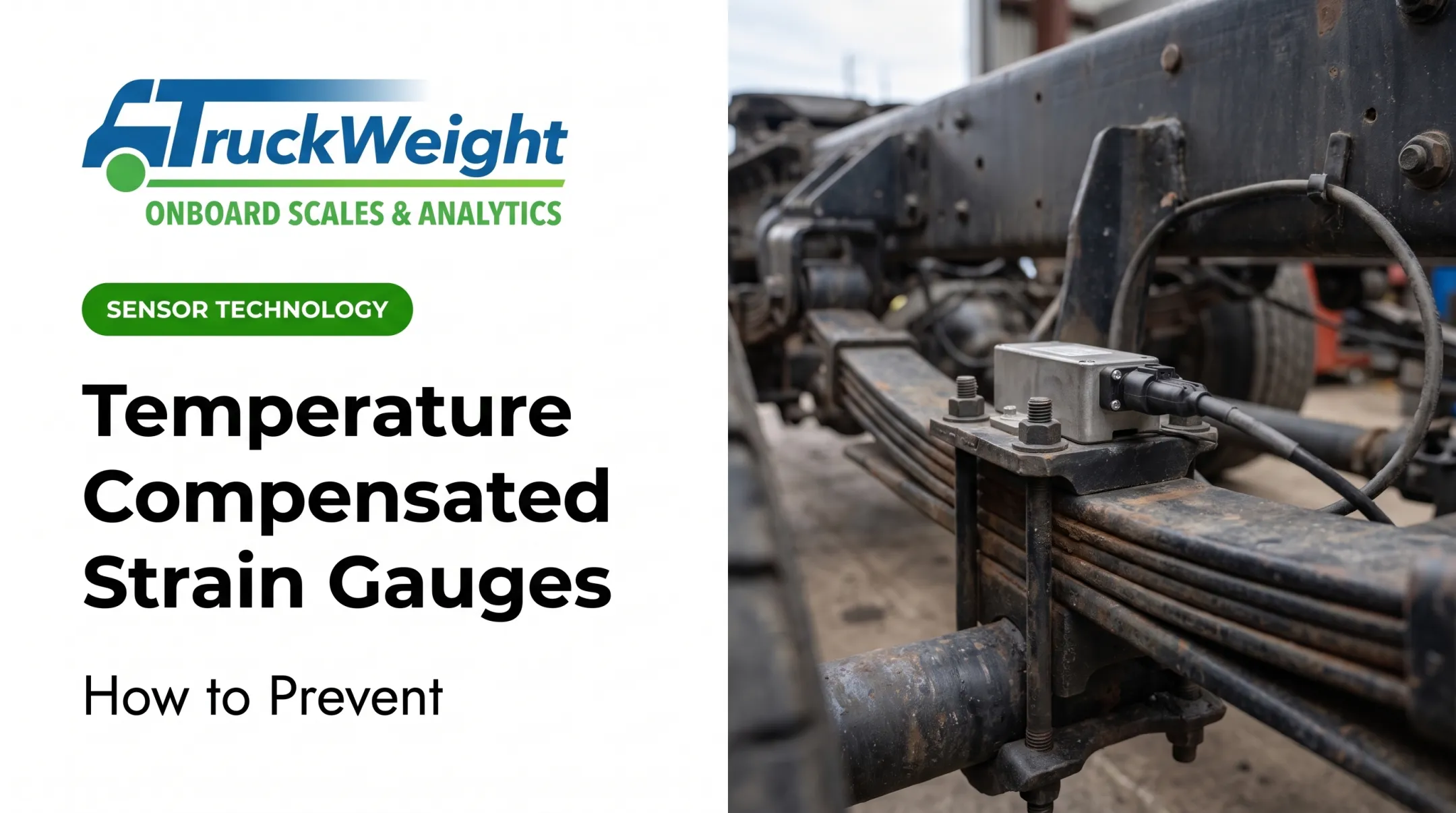
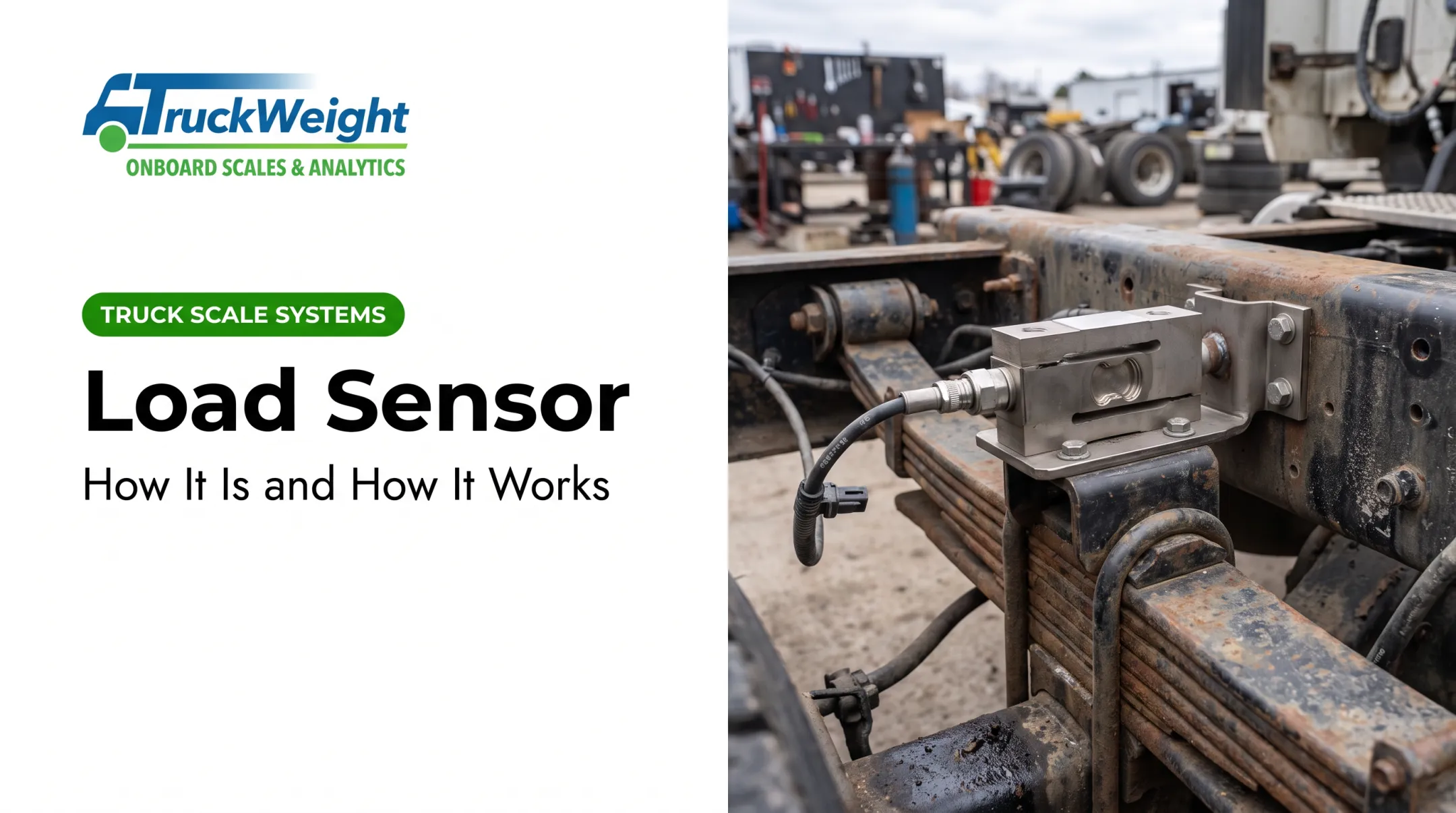
In commercial trucking, the same principle sits behind mechanical-suspension onboard scales: strain gauges on spring or walking-beam suspensions convert axle deflection into a weight signal.
Regulation: Wheatstone Bridge & Compensation
Resistance changes from strain are tiny , often fractions of an ohm. A Wheatstone bridge circuit converts that small change into a measurable voltage output. Three configurations are common:
- Quarter bridge — one active gauge, requires a passive completion resistor
- Half bridge — two active gauges, doubles sensitivity versus quarter bridge
- Full bridge — four active gauges, highest sensitivity and best compensation

Temperature compensation is critical. Thermal expansion can create apparent strain even with zero load, and a gauge can't tell the difference between mechanical strain and thermal drift on its own.
Half- and full-bridge configurations help cancel same-sign temperature effects. Proper cable wiring (three- or four-wire) compensates for resistance changes in the lead wires themselves, per HBM's technical guidance.
Output / Result
Once the Wheatstone bridge produces a voltage signal, a signal conditioner amplifies and filters it before converting it into a strain or force value. From there, the output feeds into a display unit, data logger, or control system for monitoring or automated response.
Accuracy at this stage decides the quality of every reading that follows. Calibration errors or missed temperature compensation pass straight through to the final value, whether you are using a lab load cell or an axle-weight sensor on a commercial truck.

TruckWeight calibrates its SG strain gauge sensors against a certified platform scale with empty and loaded weight readings:
- Stores calibration data per sensor
- Keeps that data intact if a trailer moves to a different tractor
- Supports typical system accuracy of 0.3%–2% of gross vehicle weight
That margin is tight enough to flag overweight risk before a truck reaches a certified scale.
Where Strain Gauges Are Used
Strain gauges sit at the sensing layer of load cells, torque transducers, and pressure sensors, converting mechanical force into an electrical signal. They work best when a few conditions line up:
- Bonded surfaces with a predictable strain direction
- Moderate temperature swings
- Continuous or repeated load monitoring
Common industry uses include:
- Aerospace: NASA instrumented a Gulfstream III wing with 32 gauges for shear, bending, and torque, reporting RMS errors under 1% (NASA report)
- Automotive: Coil springs and control arms are gauged in suspension and durability tests to model fatigue life
- Commercial trucking: Spring-suspension gauges monitor axle and payload weights from the cab
That trucking use case is where TruckWeight's SG-1 and SG-2 mechanical strain gauge sensors fit:
- SG-1: Front-axle applications on spring-suspension trucks
- SG-2: Spring trailers, drive axles, walking-beam and Chalmers suspensions (dump, roll-off, and hydrovac trucks)
Both send readings wirelessly up to 500 feet to a handheld or long-range touchscreen display. Operators see individual axle weights, gross vehicle weight, and net weight, and can check for overweight loads without leaving the cab.
Final Thoughts
The logic behind a strain gauge stays the same on an aircraft wing or a dump truck's rear axle. Bond it correctly, convert deformation into a resistance change, run that signal through a Wheatstone bridge, and calibrate the output. Miss any one of those steps and the reading becomes unreliable.
Gauge type and installation matter as much as the sensor itself—whether you are doing lab stress analysis or keeping fleet payloads within legal limits.
Frequently Asked Questions
How much does a strain gauge cost?
Individual strain gauges typically run from a few dollars for basic foil gauges to over a hundred dollars for precision rosette gauges. Complete sensor systems like TruckWeight's SG-1 ($699) and SG-2 ($799) include mounting hardware and wireless display compatibility.
How do you measure strain?
Strain is measured by bonding a gauge to a surface and reading the resulting resistance change through a Wheatstone bridge circuit. That resistance change is then converted to a strain value using the gauge factor equation.
What does a strain gauge measure?
A strain gauge measures mechanical strain, meaning the deformation ratio of a material, not force or weight directly. That strain data gets converted into force, pressure, or weight values inside a calibrated transducer.
What are the different types of strain gauge sensors?
Common types include bonded metallic foil (most widely used), semiconductor/piezoresistive (higher sensitivity), and configuration variants like linear, rosette, and shear gauges.
What are the uses of strain gauge sensors?
Strain gauges are used in load cells, structural monitoring, aerospace and automotive fatigue testing, and vehicle weighing systems like TruckWeight's onboard axle sensors.
What is the lifespan of a strain gauge sensor?
Lifespan depends heavily on cyclic loading and installation quality. Manufacturer fatigue data shows properly bonded gauges can handle anywhere from thousands to over 100 million cycles, depending on gauge series and strain amplitude.