
The load cell market reflects how essential this technology has become. One estimate puts the global market at $3.31 billion in 2024, growing to $5.193 billion by 2035 (Market Research Future). Other publishers use different scopes and land on different numbers, but the direction is consistent: demand keeps climbing.
Despite that growth, many fleet operators and engineers use load sensors daily without understanding what happens inside them. That gap leads to poor sensor selection, misread outputs, and preventable compliance headaches. This guide breaks down what a load sensor is, how it works step-by-step, and where it earns its keep in real operations.
Key Takeaways
- A load sensor (load cell) converts mechanical force into an electrical signal for weight or force measurement
- Strain gauge sensors are the most common type, detecting deformation through resistance change
- The process: force application → deformation → signal conversion → calibrated output
- Applications span trucking, industrial weighing, construction, and material testing
- Sensor choice depends on capacity, accuracy needs, and environmental durability
What Is a Load Sensor?
A load sensor is an electro-mechanical device that detects force or weight and converts it into a readable electrical signal. FUTEK defines it plainly as a force transducer — something that measures force and produces a standardized electrical output (FUTEK).
Why does this matter? Because you can't eyeball 34,000 pounds on a tandem axle. Operators and engineers need real-time, non-visual force measurement that's consistent and repeatable.
What a load sensor is NOT:
- A scale display (that's just the readout, not the sensing element)
- A pressure sensor for fluid or gas only — load cells measure applied force, not fluid dynamics
Load sensors remain essential for compliance, safety, and payload optimization—especially when axle limits and gross vehicle weight leave no room for guesswork.
Major Types of Load Sensors
| Type | Mechanism | Best For |
|---|---|---|
| Strain gauge | Resistance changes as metal deforms | Broad industrial and vehicle use |
| Hydraulic | Weight changes internal fluid pressure | Remote or electrically harsh locations |
| Pneumatic | Force balance via air/nitrogen chambers | Clean or safety-sensitive settings |
| Capacitive | Diaphragm changes distance between plates | Precision, low-force applications |
| Piezoelectric | Crystal generates charge under force | Fast dynamic events |

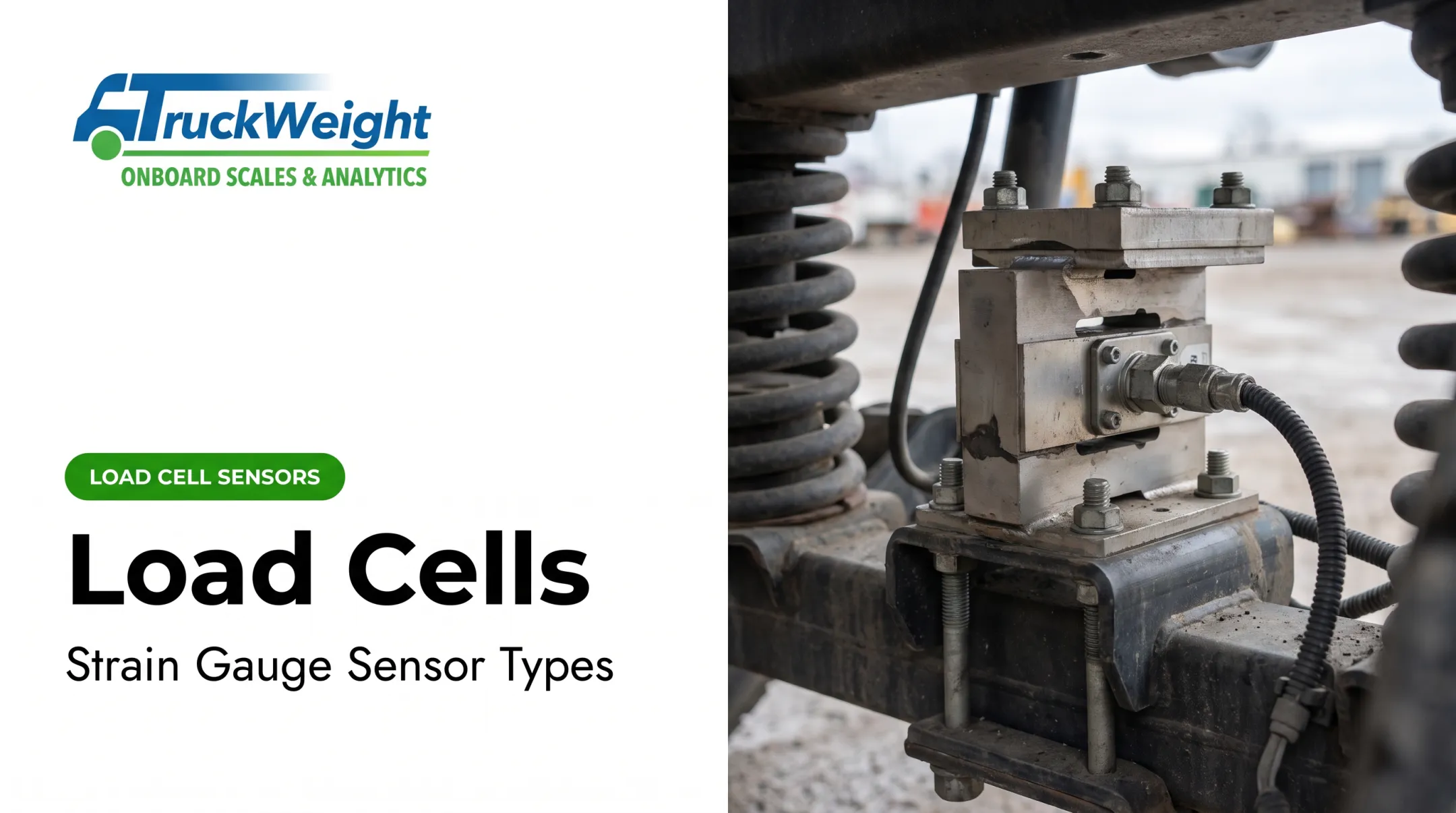
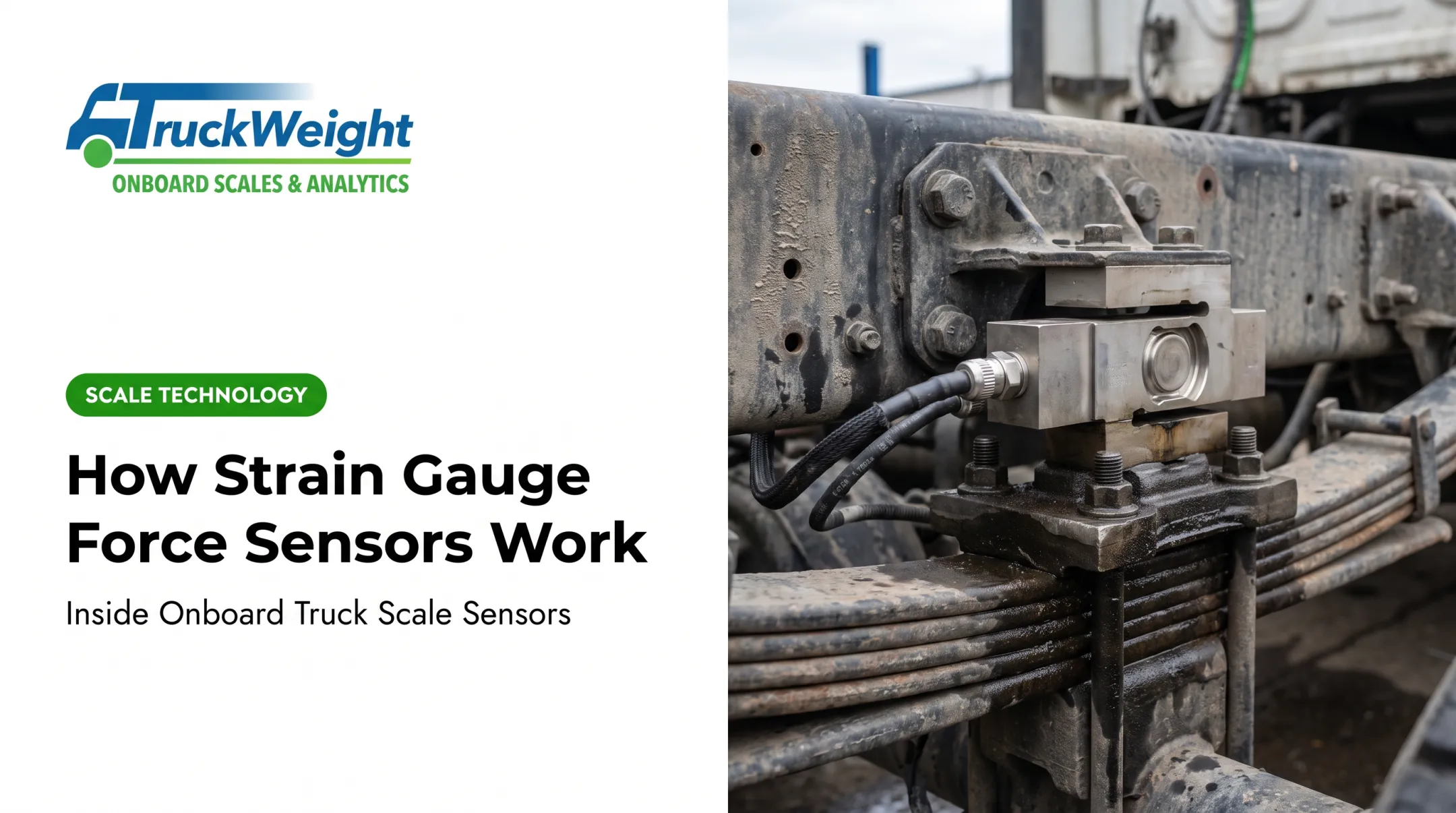
On commercial trucks, strain gauge sensors (such as TruckWeight SG-1/SG-2) fit spring and walking-beam suspensions, while air-suspension sensors track temperature and pressure changes on air-ride equipment—so fleets can match the sensing method to the suspension, not the other way around.
How Does a Load Sensor Work?
A load sensor follows a defined sequence: force hits the sensor, the sensing element deforms, that deformation generates a signal, and the signal converts into a usable output.
Initiation (Force Application)
The process starts when weight or force contacts the sensor's body or sensing element. This can happen:
- Continuously: like a truck loading material while an onboard scale tracks weight in real time
- Intermittently: like a material test bench applying force in controlled bursts
Common bottlenecks at this stage include improper mounting and off-center loading, both of which skew readings before the sensor even gets a fair shot at measuring accurately.
Core Operation (Strain Gauge Method)
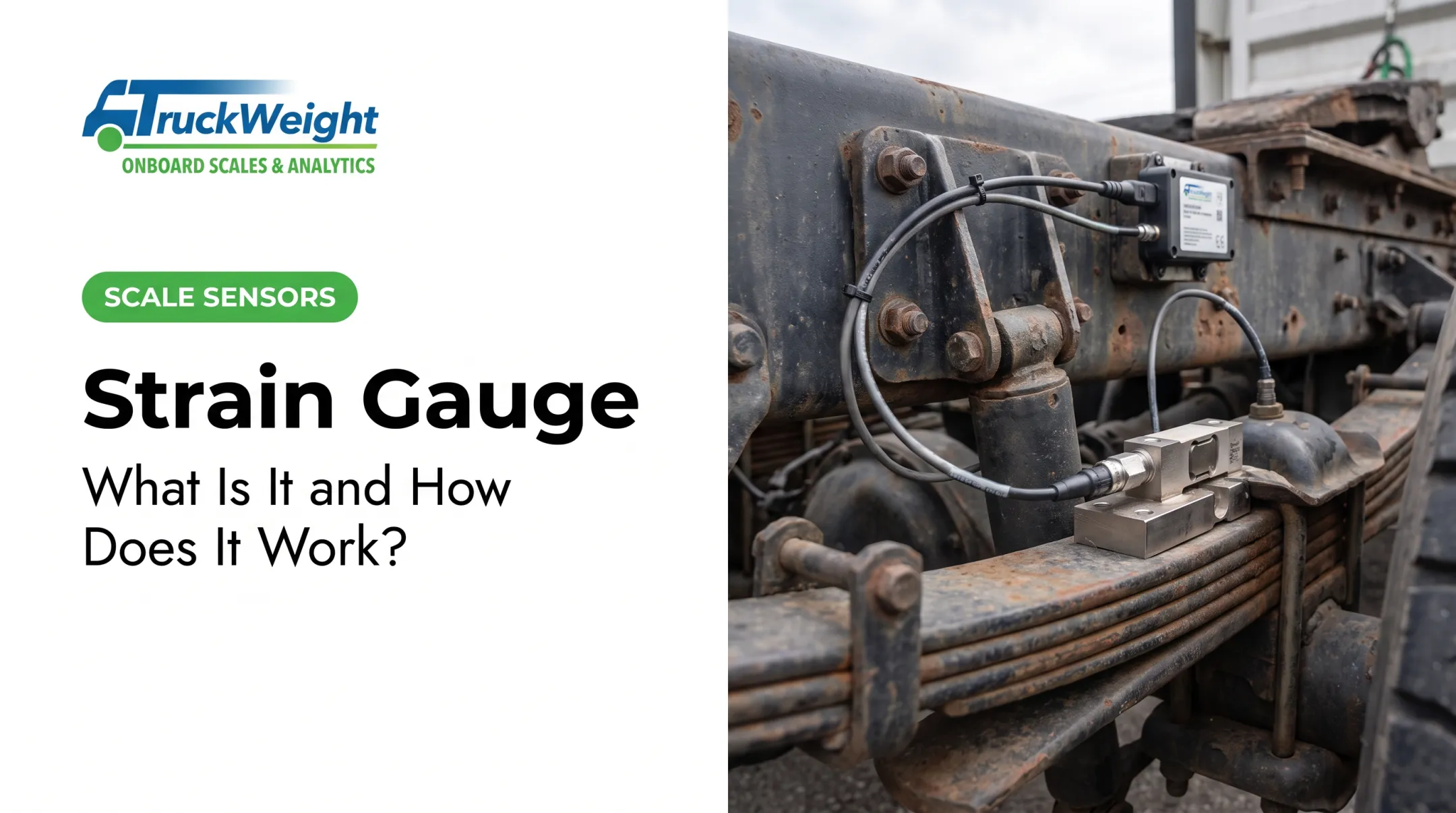
Here's the simple version: a strain gauge is a thin metal foil bonded to the sensor's elastic element. When force deforms that element, the foil stretches or compresses, and its electrical resistance changes proportionally.
That resistance change is tiny, far too small to read directly. This is where the Wheatstone bridge circuit comes in. HBK describes it as four resistance arms wired together with an excitation voltage in and an output voltage out (HBK).
When strain unbalances the bridge, the resulting voltage difference becomes the measurable signal, which gets amplified into something a display or system can use.

A full bridge configuration (using active gauges on all four arms) improves temperature compensation and cancels out common-mode noise. This directly affects three things fleet buyers care about:
- Accuracy: how close the reading is to true weight
- Load capacity: how much force the sensor can handle before damage
- Response speed: how fast the reading stabilizes
TruckWeight states its SG-1/SG-2 strain gauge sensors hit 0.3% to 2% accuracy of gross vehicle weight, while its patented air suspension sensors run tighter at 0.3% to 1% in all weather conditions.
Regulation (Calibration and Compensation)
Raw signal output isn't a legal weight reading. It has to be calibrated against known references first.
Calibration typically works like this:
- Take empty and loaded weight measurements from a certified ground scale
- Record the corresponding strain or PSI readings from the sensor
- Map those values so the sensor's output translates to accurate weight
- Recalibrate after suspension changes or component swaps
TruckWeight's back-office workflow through TruckWeight Analytics (TWA) supports this remotely. Authorized users review fleet weight data, spot abnormal readings, and calibrate sensors from any location using the Hub interface, with no need to pull a truck off the road for a manual check.
For field drift correction, a PSI difference exceeding 0.3 PSI between axle groups can signal an unlevel surface rather than a sensor problem, which is a useful diagnostic detail if you're troubleshooting inconsistent readings.
Skipping calibration is how fleets end up with two costly outcomes: overweight fines from underreported loads, or wasted capacity from overly conservative readings.

Output / Result
The final output is a digital or analog reading: gross weight, net weight, or axle-group weight, delivered to a display, telematics system, or fleet software.
TruckWeight's long-range handheld display, for example, shows axle weights, gross vehicle weight, and net weight along with trailer ID, readable up to 500 feet away. Separately, TruckWeight Analytics runs on Google Cloud Platform infrastructure (Firestore, BigQuery, PubSub) to push that same weight data into telematics APIs and cloud dashboards in near real time.
Consistent output at this stage is what cuts overweight violations and improves payload optimization. A sensor that drifts by even 3% can mean thousands of dollars in fines or wasted capacity on every haul.
Where Load Sensors Are Used
Load sensors show up at several points in a typical operational workflow:
- Production line quality control: verifying part weight before shipment
- Vehicle payload monitoring: tracking axle and gross weight during loading
- Material testing: measuring force to failure in labs
- Structural monitoring: watching load on supports over time
They perform best in tough environments: high-vibration trucking cabs, humid or dusty construction sites, and outdoor settings with wide temperature swings.
In commercial trucking, wireless strain gauge and air suspension sensors let operators monitor axle and gross weights from the cab. Mining, construction, and refuse fleets use the same onboard approach.
TruckWeight customer Tri County Block & Brick runs this setup across seven daily loads of sand and stone near a quarry, cutting wasted trips from inaccurate loading. Ritcey & Sons relies on similar onboard sensors to stay legal under strict weight limits.
How to Choose the Right Load Sensor
Selecting the right sensor comes down to four core factors:
- Load capacity/range — match the sensor to expected minimum and maximum force
- Required accuracy — tighter tolerances cost more but prevent compliance errors
- Environmental durability — check IP ratings for dust and water, plus U.S. hazardous-location (Class/Division) ratings where needed
- Connectivity — wired for predictable power, wireless for flexible installation

Application type matters too. Static loads (like a loaded trailer at rest) behave differently than dynamic loads (like a truck in motion). Match the sensing technology to that duty cycle:
- Strain gauge — handles static and dynamic truck loads well for most fleet use
- Piezoelectric — best for fast dynamic events and impact-style force changes
- Capacitive — suits low-force precision work outside heavy-haul duty
Rugged, self-installable wireless systems help fleets get sensors online quickly. TruckWeight's SG and air suspension sensors, for example, install with a standard toolkit in minutes—no specialized expertise required.
For extreme-duty fleets, the MG-3 military-grade sensor adds:
- Waterproof, shock-resistant, zero-wear construction
- 2-year warranty coverage
- Fit for spring-suspension trailers, dump trucks, and refuse rigs that take a daily beating
Conclusion
A load sensor's job boils down to one continuous process: convert physical force into an electrical signal through deformation, measurement, and calibrated output. Understanding that chain matters practically. Fleets that know how their sensors work make better decisions about accuracy requirements, calibration frequency, and hardware selection.
Accurate onboard scales keep trucks compliant, help avoid fines, and maximize payload on every haul.
Frequently Asked Questions
What is a load sensor?
A load sensor converts mechanical force or weight into an electrical signal for measurement. Trucking, manufacturing, and construction use them for real-time, accurate force data.
How does a load sensor work?
Force on the sensor deforms its sensing element slightly. That deformation changes electrical resistance, which is converted into a measurable signal and calibrated as a weight or force reading.
What is a strain gauge sensor?
A strain gauge is the most common load sensor component. It is a thin metal foil bonded to an elastic element that changes resistance as it stretches or compresses under load.
How is strain measured?
Strain is measured using a Wheatstone bridge circuit, which detects tiny resistance changes in the strain gauge and converts them into a voltage signal. That signal is then amplified into a usable output.
How do you size a strain gauge?
Match the gauge's capacity to the expected load range, including peak and shock loads. Confirm the mounting surface supports consistent, centered force without off-axis loading.
What industries rely most on load sensors?
Trucking, manufacturing, construction, and material testing rely heavily on load sensors. In trucking, they support onboard payload monitoring and axle-weight compliance.