
That's the real risk. Choosing the wrong sensor type causes inaccurate readings, unplanned downtime, or worse: regulatory violations that cost fleets real money. For trucking operations specifically, an overweight axle isn't just a fine. It's lost revenue and wasted trip time.
This guide breaks down how weight sensors and load cells actually work, the main types available, where they're used, and how to pick the right one, including onboard truck weighing systems built for compliance on the road.
Key Takeaways
- Load cells convert force into an electrical signal and are the standard weight-sensing device
- Strain gauge designs lead most industrial jobs; capacitive, piezoelectric, hydraulic, and pneumatic types fill niches
- Real-world accuracy depends on calibration, temperature compensation, and correct capacity selection
- Wireless onboard truck scales use the same technology to stop overweight violations and maximize legal payload
What Is a Weight Sensor and How Does It Work?
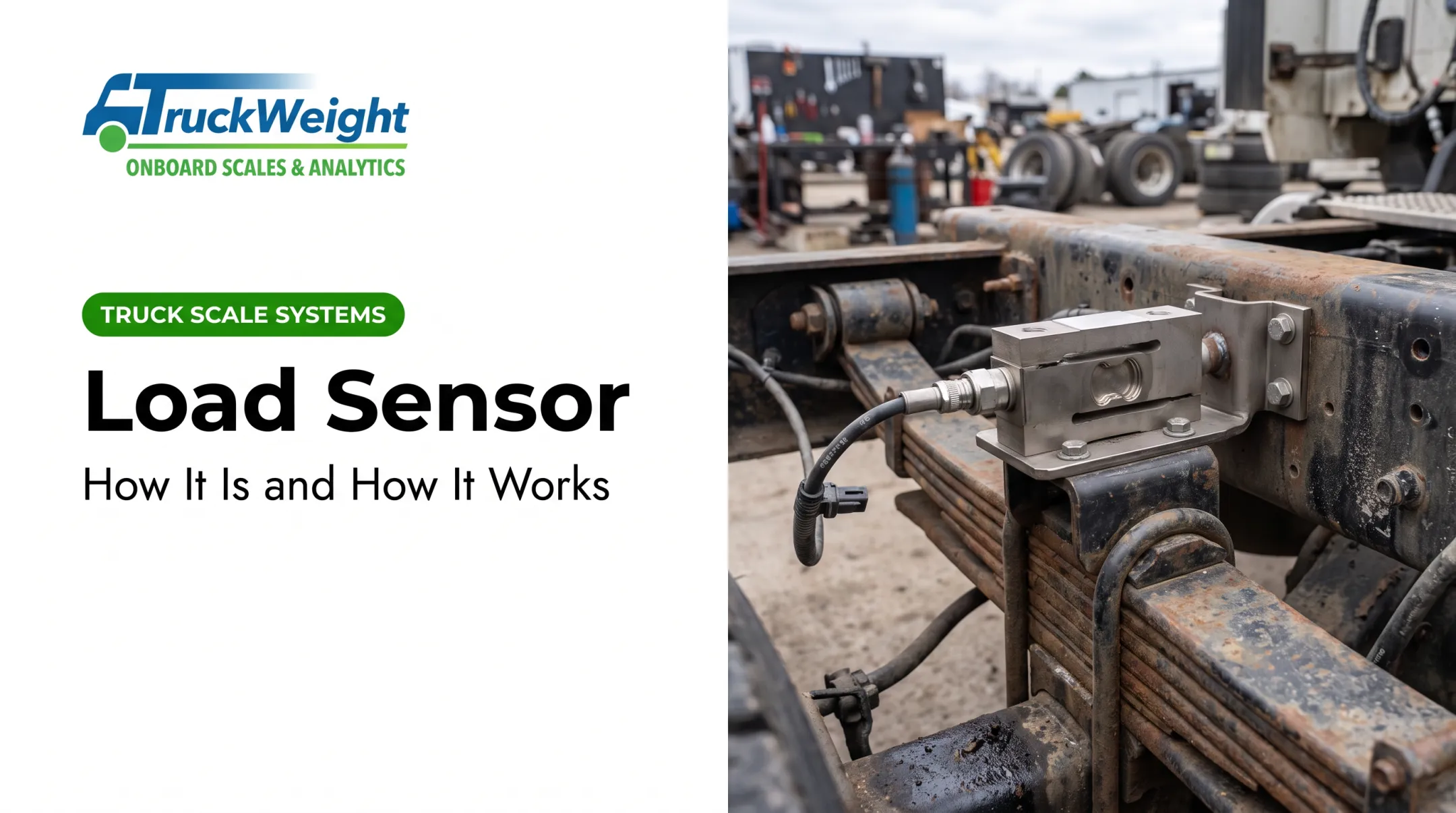
A weight sensor, or load cell, is a transducer: a device that converts mechanical force into a measurable electrical signal. A sensor is the broader term for any device that detects a physical stimulus. Every load cell is a transducer, but not every sensor converts energy the same way.
Here's the mechanical chain, step by step:
- Force is applied to the load cell's metal flexure
- Strain gauges bonded to the flexure deform, changing their electrical resistance
- A Wheatstone bridge configuration measures that resistance change as a voltage imbalance
- A signal conditioner amplifies and cleans up the raw signal
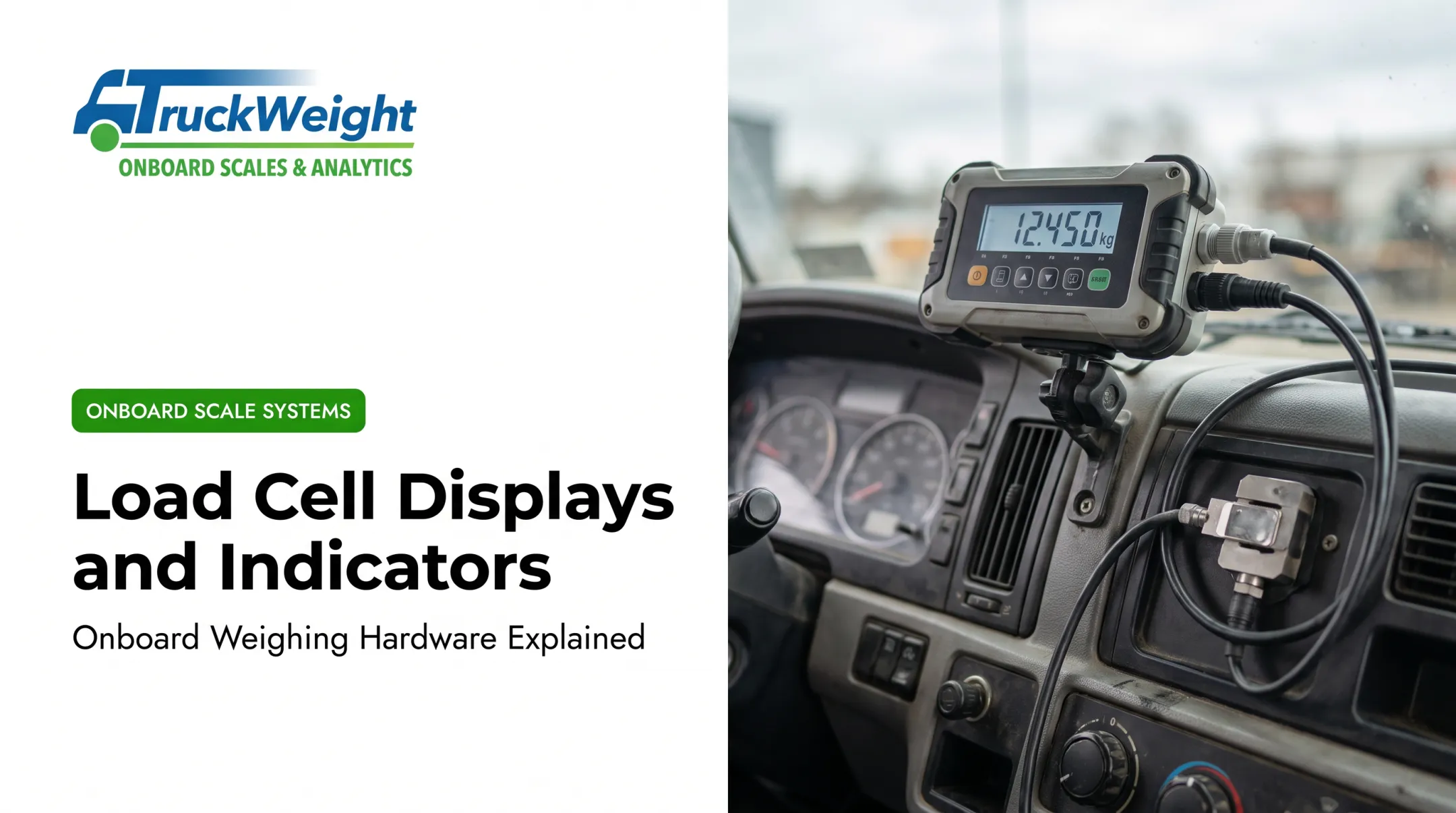
- A weight transmitter or display converts the signal into a readable number

FUTEK's engineering documentation confirms this architecture. Foil gauges bonded to a flexure change resistance under load, and the bridge circuit reads the imbalance, with no load producing a near-zero baseline output.
A complete weighing system needs all five pieces working together, not just the load cell itself. When people say "load cell weight sensor," they're almost always referring to this strain-gauge-based design. It's the industry default because it's reliable, well-understood, and scales from lab sensors to multi-ton truck and industrial applications.
Types of Weight Sensors and Load Cells
Not every application needs the same load cell design. The load path, environment, and response speed all matter.
Load Cell Types
Most industrial load cells use strain gauges. Housing shape and mounting decide how force moves through the sensor:
- Compression cells — built for presses, clamping, and high-capacity weighing where force pushes inward
- Tension cells — inline designs that measure pulling force; pancake variants suit compact spaces
- Shear beam / single-point cells — handle off-center loading on platforms, hoppers, and batching systems
- Column/canister cells — compact, high-capacity compression cells for single- or multi-point weighing systems
Other Weight Sensor Technologies
Beyond strain gauges, a few other technologies fill specific gaps:
- Capacitive sensors — force changes plate spacing and capacitance; fast response and high sensitivity for lab and medical instruments
- Piezoelectric sensors — generate charge under dynamic force; suited to impact and vibration monitoring
- Hydraulic sensors — convert force to fluid pressure with no electrical parts; useful in hazardous or explosive environments
- Pneumatic sensors — force-balance design using air or nitrogen; tolerate temperature swings but respond slower and need clean, dry gas

Force, pressure, and torque sensors are related but distinct. They measure different quantities and are not direct substitutes for a weight sensor, even when the transducer principle overlaps.
Common Applications of Weight Sensors and Load Cells
Load cells show up almost anywhere force needs to be measured.
- Manufacturing and QC — packaging drop tests, material-strength checks, belt-tension monitoring
- Retail/POS — platform and single-point cells built into commercial scales
- Medical devices — infusion pumps regulate fluid delivery and detect blockages; patient lifts use load cells for safe weight limits
- Agriculture — feed systems, livestock scales, planter downforce, and grain-yield monitoring
- Aerospace — load cells and load pins determine aircraft empty weight and center of gravity, critical for safe balance calculations
- Automotive safety — seat-pan and steering-column cells in crash testing, plus occupant-classification systems linked to airbag controls
Onboard Vehicle Weighing for Trucks and Trailers
Onboard weighing is where load cells most directly affect fleet cost and compliance. Federal weight limits cap gross vehicle weight at 80,000 lb, with 20,000 lb on a single axle and 34,000 lb on tandem axles, subject to bridge-formula restrictions. Miss those numbers, and you're looking at fines and delays.

Wireless onboard scale systems solve this by letting drivers check axle and gross weight from the cab, before ever hitting a public scale.
TruckWeight builds this technology into a few distinct sensor lines:
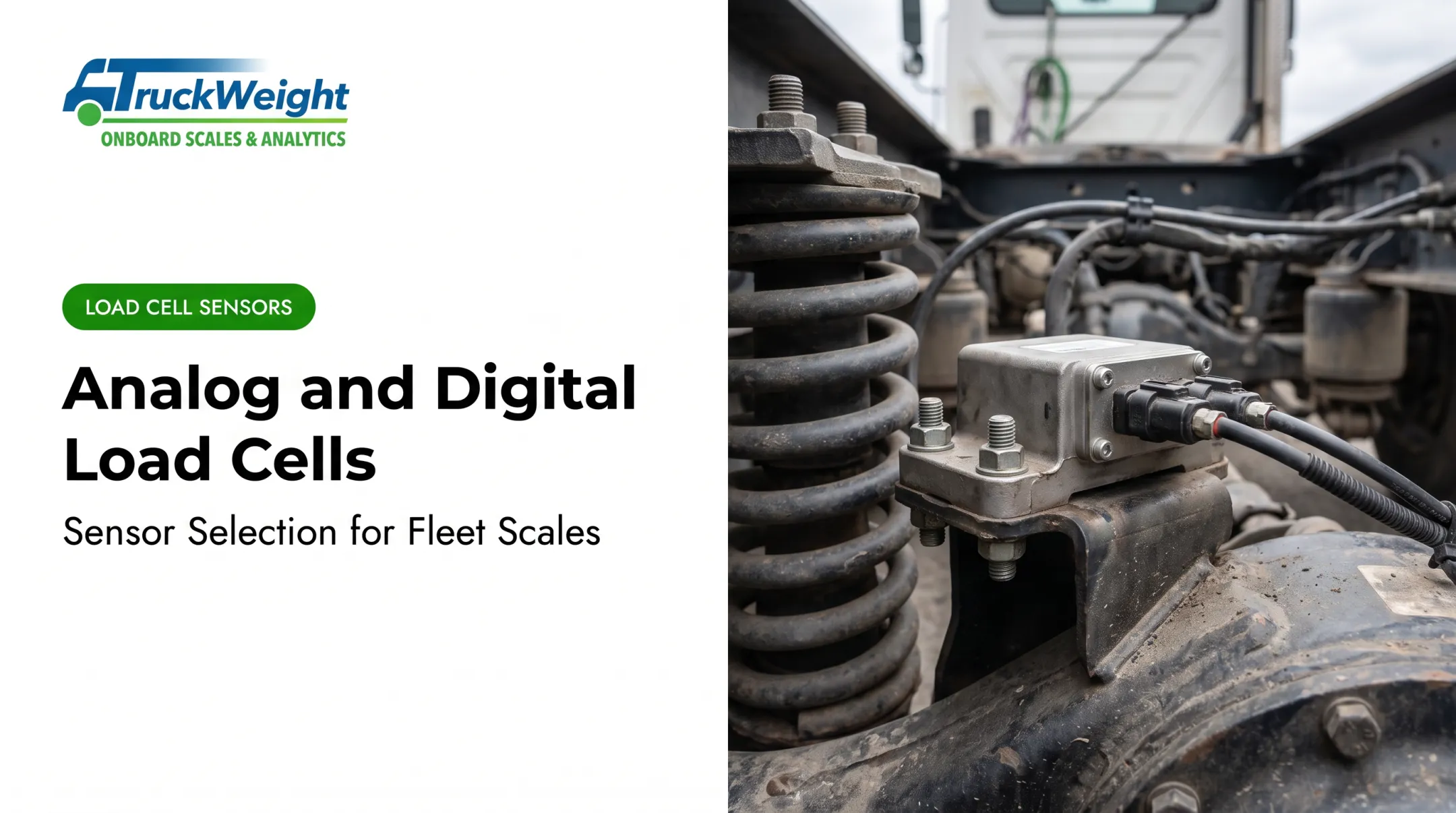
- SG-1 and SG-2 strain gauges — for mechanical, spring, and walking-beam suspensions, including spring trailers, drive axles, and Chalmers systems (0.3–2% of GVW)
- Air suspension sensors — use temperature and pressure changes in the suspension to calculate axle and gross weight, with stated accuracy of 0.3% to 1% in all weather conditions
- MG-3 military-grade sensors — built for air or non-air suspensions alike, with a "zero wear and tear" durability claim and a 2-year warranty
That distinction between direct load-path sensors and suspension-based inference matters. A load cell mounted between chassis and body measures weight independently of suspension behavior, while an air-pressure system infers weight from suspension response. Fleets choosing between the two should match the sensor type to the suspension they're actually running.
How to Choose the Right Weight Sensor or Load Cell
Picking a sensor comes down to a handful of practical questions.
Match capacity to the job. Select a sensor rated above your maximum expected load, factoring in side loads and off-axis forces. For continuous use, stay at or under 50% of rated capacity unless the cell is specifically fatigue-rated.
Check environmental resilience. Waterproofing, temperature range, and shock resistance all matter for rugged fleet or industrial use. A sensor rated for a climate-controlled lab won't survive a gravel pit.
Confirm mounting compatibility. Thread type, inline versus flange mounting, and thru-hole options all affect installation complexity.
Beyond the sensor itself, evaluate the supplier:
- Does the company offer calibration support after the sale?
- Is there ISO certification backing the manufacturing process?
- Is the design rugged enough for demanding fleet conditions?
TruckWeight, for example, holds ISO 9001:2015 registration covering the design and manufacture of non-legal-for-trade onboard truck scales and weight monitoring systems. Its wireless systems are built for self-installation: included parts, an instructional video, and no specialized tools required.
That stands in contrast to traditional wired load cell setups, which typically need surface prep, hand-bonded gauges, and careful cable routing that take considerably longer to get right.
Accuracy, Maintenance, and Common Issues
Even a well-built sensor drifts if it's not maintained properly.
Factors that hurt accuracy:
- Temperature drift — output shifts as ambient temperature changes
- Off-axis loading — force applied at an angle instead of straight through the load path
- Overloading — exceeding rated capacity, even briefly, can cause permanent damage
- Electrical interference — noisy environments distort the signal before it reaches the display
Common problems to watch for:
- Zero-point drift — the baseline reading shifts away from true zero over time
- Unstable readings — display values jump or flutter under a steady load
- Mechanical creep — the reading slowly changes under sustained load with no change in force

Regular calibration and quality-control monitoring address most of these issues before they become expensive problems. TruckWeight's remote calibration service, for instance, lets fleets calibrate and reconfigure onboard scale sensors from the cloud rather than pulling trucks off the road for manual recalibration.
Electronic weight scales deliver high accuracy when they are installed correctly, calibrated on schedule, and maintained over time. Treat accuracy as an ongoing operating result, not a one-time factory rating.
Frequently Asked Questions
How much does a weight sensor cost?
Cost varies widely. Basic strain gauge modules can run about $5–$50 each, while industrial or vehicle-grade systems with calibration and support often cost $1,000 or more, depending on capacity, accuracy, and ruggedness.
How does a weight sensor work?
Force deforms a strain gauge bonded to a metal flexure, changing its electrical resistance. A Wheatstone bridge circuit converts that resistance change into a voltage signal, which is then amplified and displayed as a weight reading.
What is a load cell weight sensor?
It's a strain-gauge-based device—the most common weight sensor in weighing systems, from bench scales and industrial platforms to onboard vehicle scales.
What are the different types of weight sensors?
The main categories are strain gauge/load cell, capacitive, piezoelectric, hydraulic, and pneumatic. Each fits different load, speed, and environmental requirements.
Are electronic weight scales accurate?
Generally, yes. Accuracy depends on proper calibration, temperature compensation, and correct mounting. A poorly calibrated scale can be off by a wide margin even with good hardware.
What is the difference between a transducer and a sensor?
All load cells are transducers, since they convert force into an electrical signal. "Sensor" is the broader term for any device that detects a physical stimulus, whether or not it converts energy between forms.