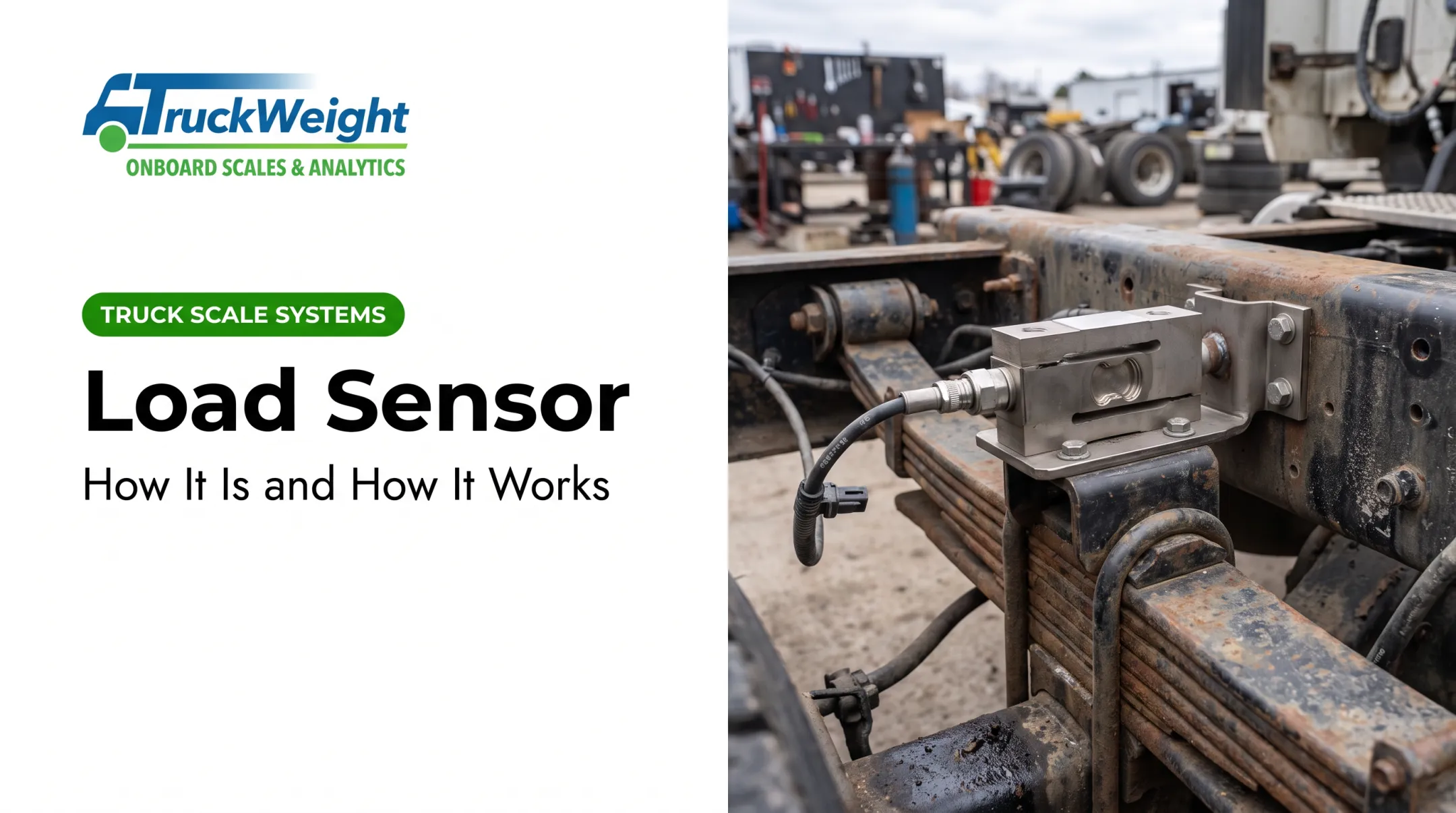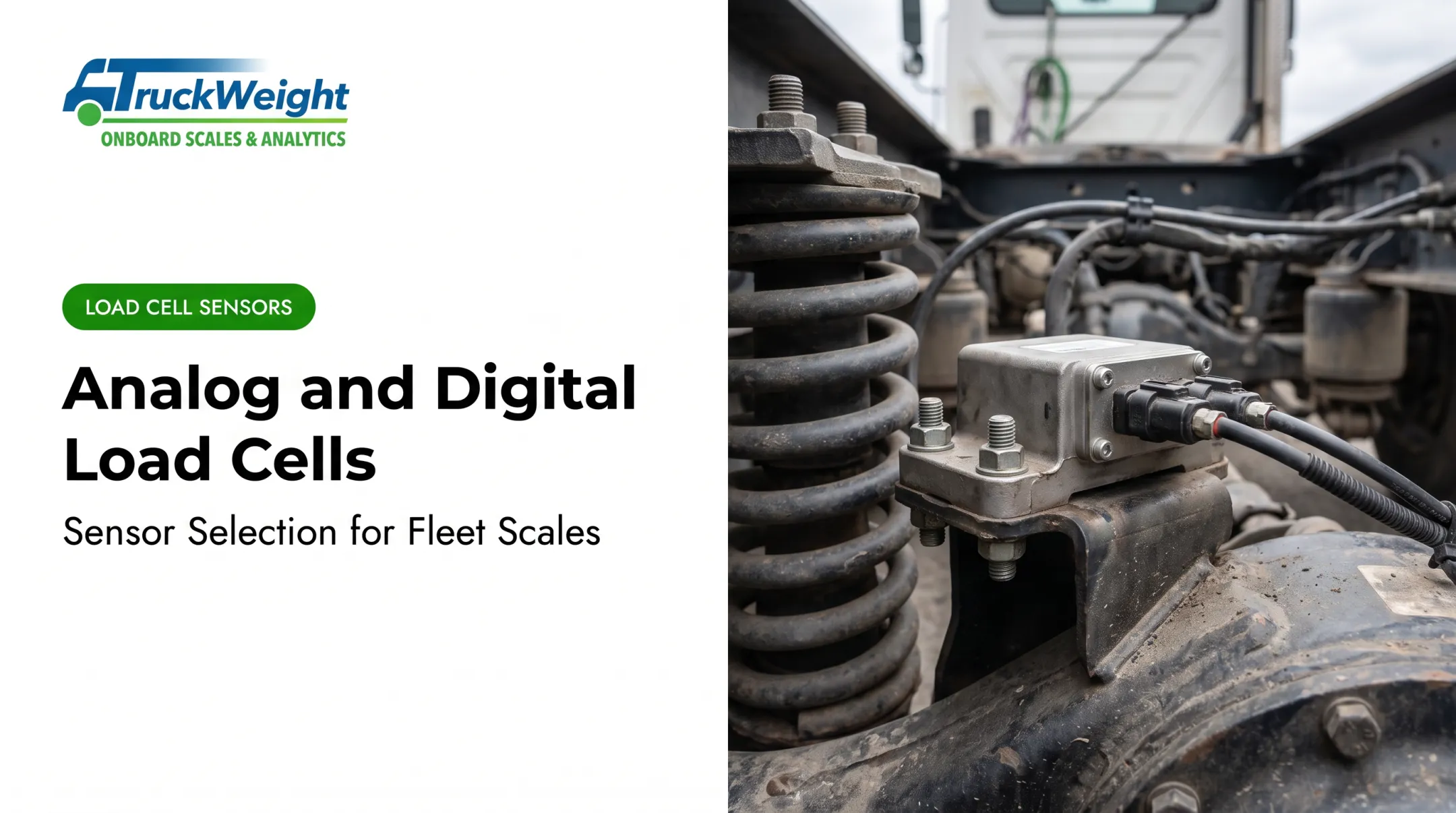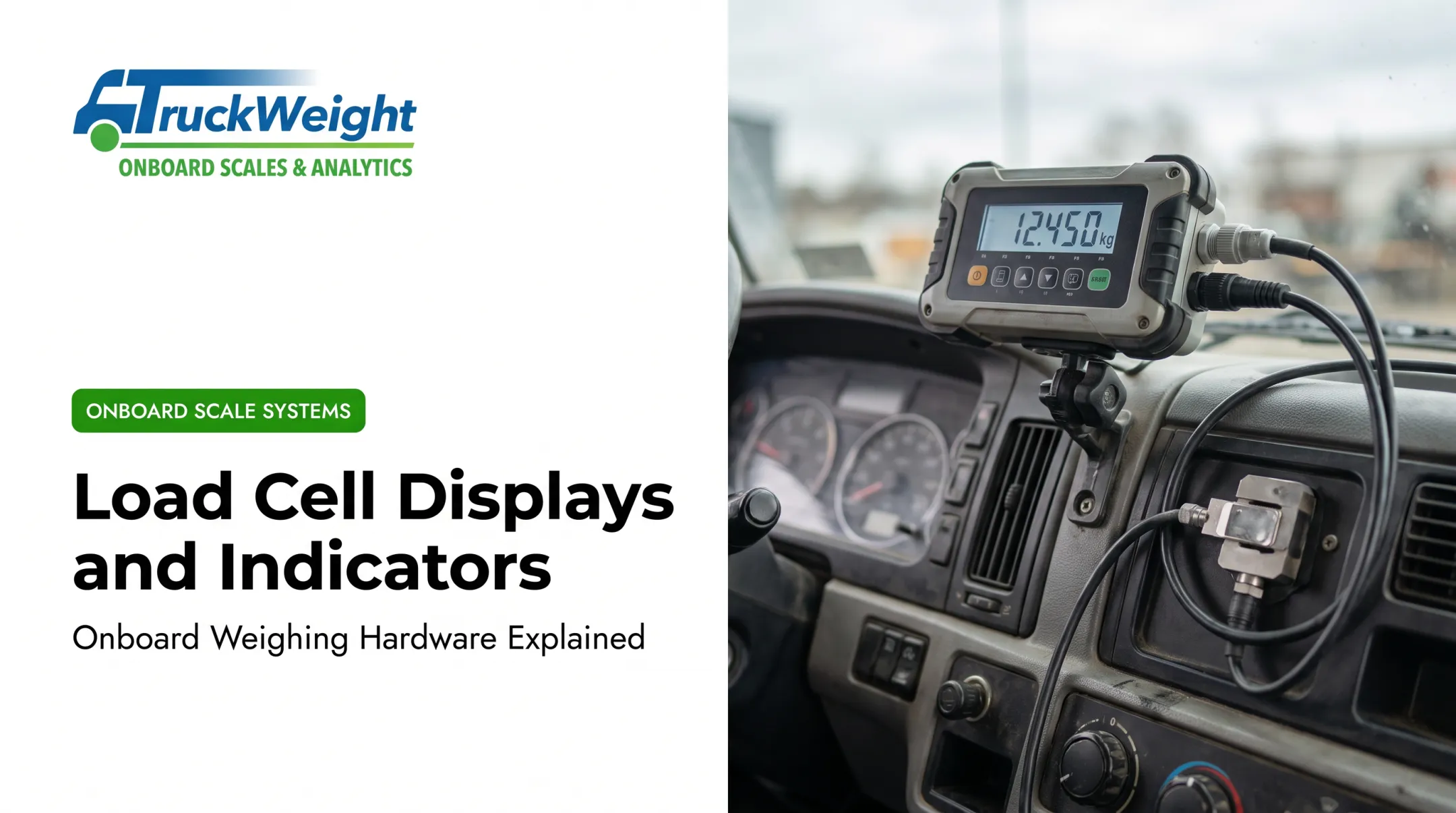

Whether it's a platform scale at a distribution center or a sensor tucked into a truck's suspension, load cells are the quiet workhorses behind accurate weight and force measurement. They matter because the consequences of bad data are expensive — fines, safety violations, ruined product batches, and equipment damage.
At TruckWeight, this isn't theoretical. Our systems rely on strain gauge sensors and patented air suspension sensor technology to help commercial fleets weigh loads accurately, right from the cab. This article breaks down the main types of load cells, how they differ, and how to pick the right one for your application.
Key Takeaways
- Load cells are transducers that convert force into a measurable electrical signal.
- Four main types exist by operating principle: strain gauge, hydraulic, pneumatic, and capacitive.
- Strain gauge cells dominate industrial and vehicle weighing thanks to accuracy and durability.
- The right choice depends on load range, environment, accuracy needs, and installation constraints.
What Is a Load Cell?
A load cell is a transducer — a force gauge that converts mechanical force (tension, compression, or shear) into a proportional electrical signal. A display or data system then calibrates that signal and converts it into a weight or force reading.
Load cells aren't abstract lab equipment. They're embedded in:
- Vehicle suspensions and onboard weighing systems
- Industrial platform and floor scales
- Hydraulic presses and testing machines
- Storage tanks and silos
In short, they turn force into usable data—often out of sight—inside the scales, presses, tanks, and trucks that depend on accurate weight.
Why Are Load Cells Important?
Accurate force measurement drives compliance, safety, and product quality across industries. Without it, things break down fast:
- Inconsistent fill weights lead to product waste or short-filling
- Overloaded axles cause premature wear and road-safety risks
- Failed inspections translate directly into fines and downtime
According to NIST, US commercial transactions covered by weights-and-measures regulation totaled $12 trillion in 2022 — 45% of US GDP. That volume of trade rides on accurate sensors.
On the trucking side, FMCSA's 2023 Pocket Guide reported over 2 million vehicle inspections and more than 3.1 million vehicle violations in 2022 alone. Not all of those are weight-related, but overweight axles remain a persistent, costly compliance headache for fleets.
Different environments and load ranges call for different sensor technologies. That's where load cell types come in.
Types of Load Cells
Load cells are categorized primarily by operating principle. Each type trades off accuracy, cost, and environmental resilience differently.
Strain Gauge Load Cells
Strain gauge cells are the industry workhorse. Thin gauges are bonded to a metal beam that deforms slightly under load. That tiny deformation changes electrical resistance in the gauge, which is measured through a Wheatstone bridge: a circuit of four resistance arms arranged so even minor resistance shifts produce a readable voltage change.
How it differs: Unlike hydraulic or pneumatic types, strain gauge cells rely purely on resistance change, not fluid or air pressure. That makes them electronically precise and easy to integrate with digital displays.

Best suited for:
- Industrial scales and weighbridges
- Vehicle onboard weighing (TruckWeight's SG-1 and SG-2 sensors serve this role for spring-suspension and walking-beam trucks)
- Test and measurement labs
Key strengths:
- High accuracy and linear output
- Available in many form factors: beam, S-type, single point, compression, tension
- Industrial-grade accuracy classes range from roughly 0.0116% to 0.023%, depending on application
Limitations: Sensitive to temperature swings without compensation, and requires proper calibration and signal conditioning to stay accurate over time.
Internally, TruckWeight's SG-2 sensors are documented at 0.3% to 2% of gross vehicle weight accuracy for mechanical and spring suspensions, built waterproof and shock-resistant for the rough conditions a logging truck or refuse hauler faces daily.
Hydraulic Load Cells
Hydraulic cells use a piston that compresses a confined fluid, usually oil. The pressure rise is proportional to the applied force and gets read through a pressure gauge or transducer.
How it differs: No electrical components sit at the sensing point, which sets it apart from strain gauge designs entirely.
Best suited for:
- Very heavy loads (tank, bin, and hopper weighing)
- Hazardous or explosive environments
- Locations with limited electrical power
Key strengths: Durable, safe around flammable materials, and capable of handling enormous capacities. Some hydraulic systems handle weight ranges up to 10 million pounds.
Limitations: Lower precision than strain gauge or capacitive types. They're bulkier, slower to respond, and less common in modern digital systems.
Pneumatic Load Cells
Pneumatic cells balance the applied load against pressurized air or gas on a diaphragm. The air pressure required to balance the load indicates the weight.
How it differs: This is a force-balance method using air, not resistance or fluid pressure.
Best suited for:
- Hazardous environments requiring intrinsic safety
- Sanitary or food-grade applications
- Lower-weight scenarios needing solid accuracy
Key strengths: No sparking risk, low sensitivity to temperature swings, and decent accuracy for lighter loads.
Limitations: Slower response time and dependency on clean, regulated air supply make them impractical for heavy industrial or vehicle weighing.
Capacitive Load Cells
Capacitive cells use two parallel plates. Applied load changes the gap between them, which changes capacitance. That shift is converted into a weight signal.
How it differs: Measures capacitance change instead of resistance or pressure.
Best suited for:
- High-precision lab measurement
- Medical devices and research sensors
- Specialty applications that need extreme sensitivity
Key strengths: Very high sensitivity. Manufacturer data from Eilersen shows capacitive sensors can see capacitance changes up to 10% under load, compared to roughly 0.1% resistance change in foil strain gauges.
Limitations: More delicate and costlier. Not commonly seen in rugged outdoor or vehicle settings where strain gauge designs hold up better against shock and vibration.

How to Choose the Right Load Cell
The right type depends on your load range, environment, and accuracy needs.
Factors to Consider
- Type of force: tension, compression, or shear, plus the capacity range your application requires
- Required accuracy: legal-for-trade weighing has stricter tolerances than general-purpose monitoring
- Operating environment: temperature swings, moisture, hazardous conditions, or vibration—especially on mobile equipment, where weatherproof and shock-resistant sensors matter
- Installation complexity: wired systems versus wireless setups that fit your workflow
- Budget and upkeep: long-term maintenance and calibration costs, not just sticker price
Common Mistakes to Avoid
- Choosing a fragile, high-precision type for rugged field use. A capacitive sensor may look strong on a spec sheet, but a durable strain gauge sensor will outlast it in a gravel yard.
- Ignoring environmental exposure. Vibration and moisture kill sensors that aren't rated for the job.
- Overlooking total cost of ownership. Calibration, maintenance, and downtime add up fast. TruckWeight's strain gauge and air suspension sensors are built for five to ten years of service with minimal upkeep.
- Sticking with a familiar type instead of the right one. Popularity doesn't equal fit.

Conclusion
Load cells underpin accurate force and weight measurement—whether you're filling a hopper, testing materials, or hauling gravel down the highway. Strain gauge, hydraulic, pneumatic, and capacitive types each fit different needs around accuracy, operating environment, and budget.
Match the sensor type to the job and you get better readings and fewer failures. For commercial fleets, systems like TruckWeight's onboard scales apply that same principle on the road: the right load-cell setup supports payload accuracy, compliance, and day-to-day reliability.
Frequently Asked Questions
What is the purpose of a load cell?
A load cell converts mechanical force into an electrical signal so it can be measured, monitored, and used for weighing or process control. It's the sensing component behind nearly every automated weighing system.
What are some applications of load cells?
Industrial weighing, vehicle onboard scales, material testing, structural monitoring, and process automation all rely on load cells. They're also found in medical devices and robotics.
What are the different types of load cells?
The four main types by operating principle are strain gauge, hydraulic, pneumatic, and capacitive. Each suits different accuracy, cost, and environmental requirements.
What is an S-type load cell?
An S-type (or S-beam) load cell is a strain gauge design shaped like the letter "S," used to measure both tension and compression forces.
What types of load cells are used in weighbridges?
Weighbridges commonly use strain gauge-based compression or shear beam load cells. According to Rice Lake's engineering handbook, the double-ended shear beam is the most common design in truck scales due to its accuracy under heavy vehicle loads.
How many load cells do I need?
It depends on your platform or vehicle's support points. Trucks and platforms often need multiple sensors for stable readings. TruckWeight configurations typically use one to three sensors depending on suspension type and axle layout.